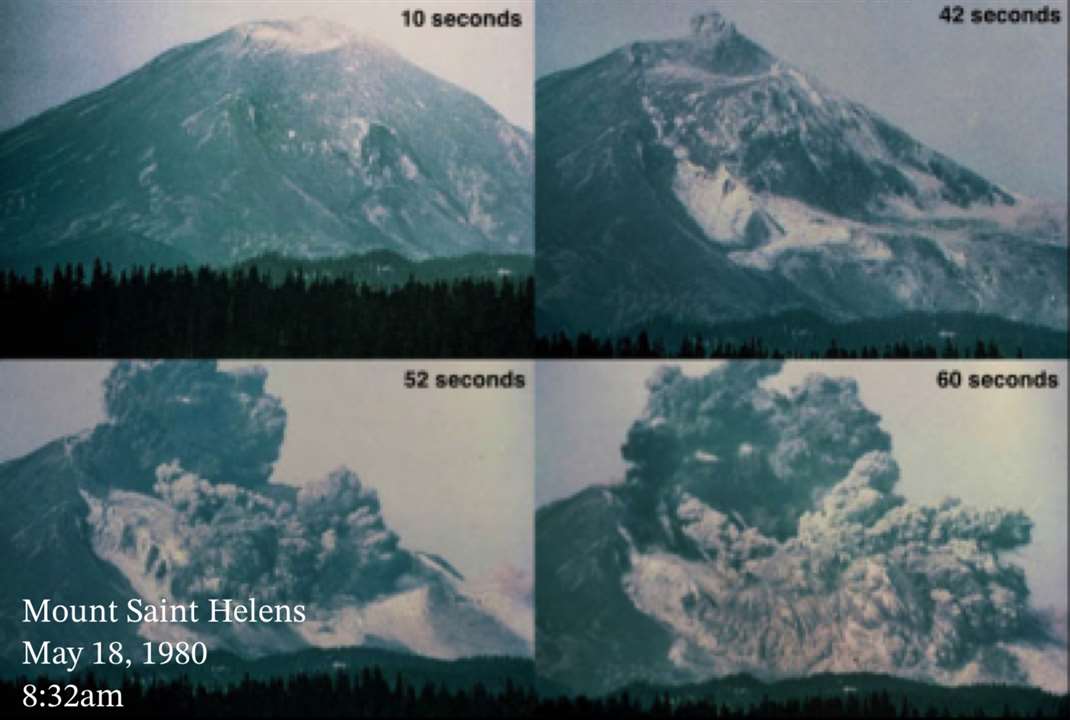
On May 18, 1980 my late husband and I lived in Chehalis, Washington, about 60 miles southwest of Mount Saint Helens. We could see the mountain from our front yard. My husband saw the start of the eruption at 8:32 am. We then drove out to a high place and watched the eruption the rest of the day.
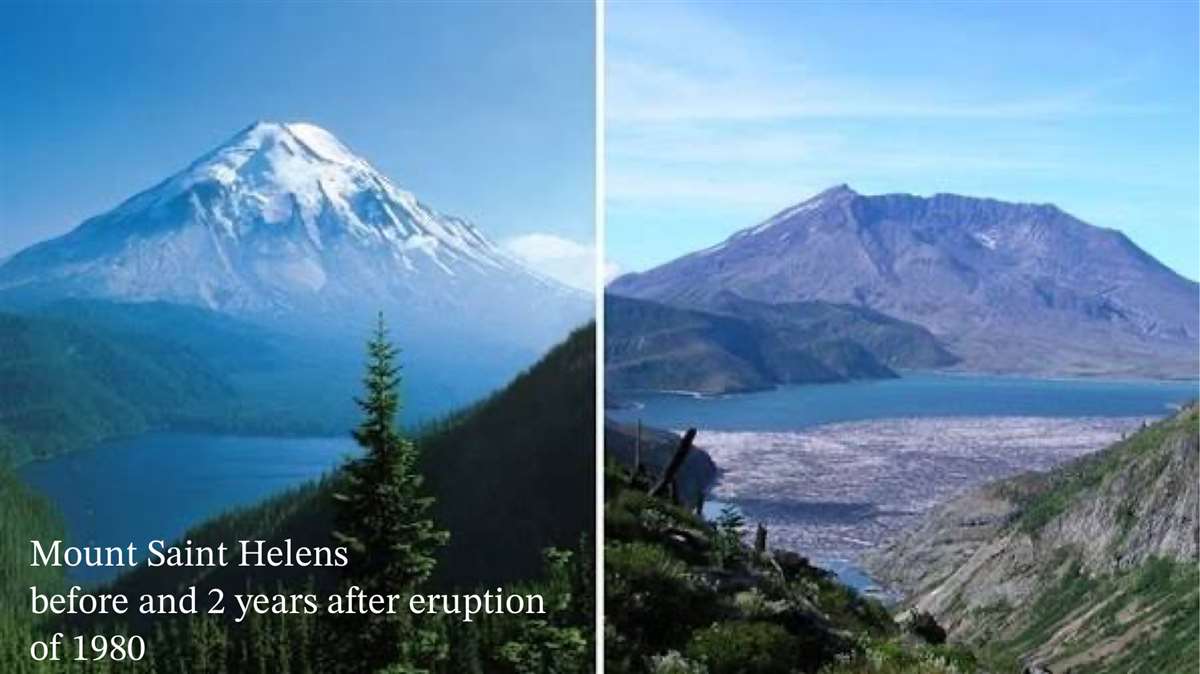
Each year I share a poem I wrote about the eruption. Following the poem I have included a Wikipedia article about the eruption. I have also included two photos, one of the initial eruption and a before and after.
*****
Remembering the eruption of Mount Saint Helens May 18, 1980. It was a terrifying beautiful awesome event.
MOUNT SAINT HELENS
When I was little I heard grown-ups
talk about the mountain erupting,
but it was Rainier they feared,
they didn't suspect the quiet sister
of harboring the earth's hot passion~
until that May morning when her face exploded
in a bitter blast of deep-held rage.
*****
On May 18, 1980, at 8:32 a.m., Mount St. Helens in Skamania County, Washington experienced a catastrophic explosive eruption which had a volcanic explosivity index of 5. It was the first to occur in the contiguous United States since the much smaller 1915 eruption of Lassen Peak in California. The main eruption was preceded by a series of volcanic explosions, pyroclastic flows, and phreatic blastsbeginning in March 1980. It has often been considered the most disastrous volcanic event in U.S. history.
The eruption was preceded by a series of earthquakes and steam-venting episodes caused by an injection of magma at shallow depth below the volcano that created a large bulge and a fracture system on the mountain's north slope. An earthquake at 8:32:11 am PDT(UTC−7) on May 18, 1980, caused the entire weakened north face to slide away, a sector collapse which was the largest subaerial landslide in recorded history. This allowed the partly molten rock, rich in high-pressure gas and steam, to suddenly explode northward toward Spirit Lakein a hot mix of lava and pulverized rock, overtaking the landslide. An eruption column rose 80,000 feet (24 km; 15 mi) into the atmosphere and deposited ash in 11 U.S. states and various Canadian provinces.
At the same time, snow, ice, and several entire glaciers on the volcano melted, forming a series of large lahars(volcanic mudslides) that reached as far as the Columbia River, nearly 50 miles (80 km; 260,000 ft) to the southwest. Less severe outbursts continued into the next day, only to be followed by other large, but not as destructive, eruptions later that year. The thermal energy released during the eruption was equal to 26 megatons of TNT.
About 57 people were killed, including innkeeper and World War I veteran Harry R. Truman, photographers Reid Blackburn and Robert Landsburg, and volcanologist David A. Johnston.
Hundreds of square miles were reduced to wasteland, causing over $1 billion in damage (equivalent to $3.5 billion in 2024).
Thousands of animals were killed, and Mount St. Helens was left with a crater on its north side. At the time of the eruption, the summit of the volcano was owned by the Burlington Northern Railroad, but the United States Forest Serviceacquired the land from the railroad after the eruption. The area was later preserved in the Mount St. Helens National Volcanic Monumentand the State of Washington recognized the month of May as "Volcano Awareness Month".
Events are held at Mt. St. Helens and within the region to discuss the eruption and safety concerns, and to commemorate lives lost during the disaster.