A Jueju is a type of poem from China where each line has either five syllables or seven syllables. The first kind is called a wujue while the second kind is called a qijue because wu and qi translate to "five" and "seven." Since a Jueju consists of no more than either 20 or 28 characters, such poems tend to make extensive use of symbolic language to communicate a great deal of information with a small amount of text. Furthermore, the process of creating a Jueju is complicated by the need to ensure the alternating of level and oblique tones in each line, which can be confusing to those who are unfamiliar with the tonal nature of the spoken Chinese language. As a result of this complexity, Jueju has been well-regarded by Chinese critics since ancient times, which is why many famous Chinese poems are written using this structure. In particular, the Tang Dynasty was famous for Jueju, which often used small occurrences to expound on grand matters.
Structure
Jueju follows one of the following tonal patterns: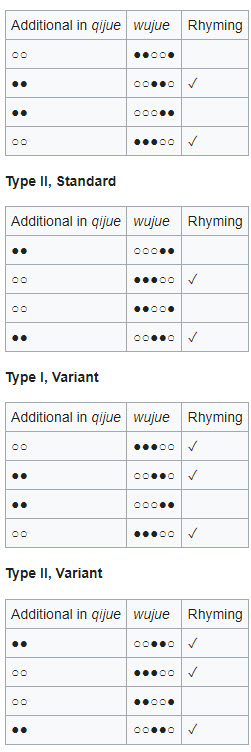
? is a character with a level tone, while
? is a character with an oblique tone (a rising, departing or entering tone).
Example
"Jueju" by Du Fu (Two Golden Orioles)
Two golden orioles sing in the green willows,
A row of white egrets against the blue sky.
The window frames the western hills' snow of a thousand autumns,
At the door is moored, from eastern Wu, a boat of ten thousand li.