Jueju may be small in size, but it carries a surprising weight of feeling. Born in classical China as a four-line verse form, it thrives on brevity, balance, and suggestion—qualities that make it remarkably at home in modern English poetry. In just a handful of words, a jueju can sketch a scene, stir an emotion, or leave a lingering silence, proving that sometimes the most powerful poems are the ones that say the least.

Like yin and yang, contrast is a key, resolving into personal truth.
East Asian Poetic Forms
Haiku, the Japanese poetic form most familiar in the West, traditionally leans toward serene, appreciative moods—celebrating nature’s fleeting beauty with quiet harmony. By contrast, jueju—the classical Chinese quatrain—embraces a far wider emotional range. Its verses can be sombre, mournful, or wistful, yet just as easily joyful and celebratory. This versatility allows jueju to probe the depths of the human psyche, often shifting tone within the same poem. Stylistically, the two forms diverge as well: symbolism is a hallmark of jueju, while haiku—at least in its classical form—relies more on direct evocation. Only modern haikuists have begun to weave symbolism into their work, narrowing the stylistic gap but preserving the distinct spirit of each tradition.
Jueju
Jueju, meaning severed sentence or cut-off lines, is a curtailed verse of Chinese origin that grew popular amongst Chinese poets during the Tang Dynasty (618–907). Traditionally, it is a single quatrain (never a chain) with the classic rhyme scheme of AAXA, or the modern version that rhymes in the even-numbered lines, abcb (a common Ballad stanza). The five-character quatrain (wujue) originated from the yuefu poetry and folk songs of the Han Dynasty, while those with seven-character lines (qijue) originated from the ballads of the Wei and Jin dynasties.
Unlike the centuries’ worth of jueju written in other languages, the English form is fairly new. Universally, the key feature of a jueju is the merger of the external world of nature and the human world of emotion. It begins with a wide lens, narrowing with each line—OR vice versa—mandatory: culminating in a personal reflection in the last phrase of the final line.
Structure of a Jueju (in English adaptation)
Even with the rules relaxed, emulating ancient jueju, the final phrases (the last 3 syllable per LINE), serve a purpose, be it in the rhythm of sound in the rhyme scheme, or the emotional arc culminating in the final phrase of the fourth line.
- Line 1 (wide lens): Sets the scene, creating a mood— often nature or seasonal imagery.
- Line 2 (zoom in): Narrows the focus, often a detail within the scene, in harmony with L1.
- Line 3 (contrast): A shift in perspective—the pivotal scene. It introduces humanity, emotion, or a twist (usually in its final phrase) setting the stage for the fourth line of the poem.
- Line 4 in Jueju (Reflection):
- Defining feature: Distinguishes jueju from Western quatrains by its reflective turn.
- Enjambment: The opening phrase often flows directly from Line 3, breaking from earlier imagery— it does not contrast or reflect the elements found in the first couplet— while staying sympathetic to the poem’s overall theme.
- Caesura: A marked pause precedes the final phrase, often introduced by a conjunction or other word which normal grammar would define whether it is read together with the final 3-syllable phrase or not, or gentle punctuation (comma, semicolon), heightening the reflective shift. This is clearly defined and not ambiguous.
- Personal resonance: The closing phrase echoes imagery from Line 1, rephrased and turned inward, creating a contemplative self-reflection.
This structure makes Line 4 both a pivot and echo—it ties the poem together while deepening its emotional impact.
MY EXAMPLE
autumn leaves drift through the air
soft winds carry whispers low
shadows linger as shared steps
echo in cliffs then let go
© Suzette Richards (2026)
In four short lines, the poem sketches a season, a mood, and a moment of human presence dissolving into nature. The language is simple, yet the effect is layered—movement, sound, silence, and release. This is the heart of jueju: the art of saying just enough, and leaving space for the reader to feel the rest.
Shortcoming: It diverges from jueju tradition in the closing line—instead of compressing the reflection into a distilled, personal three-syllable phrase, it expands into a more general, almost cinematic image (echo in cliffs then let go). That’s beautiful, but it doesn’t quite deliver the sharp, personal pivot jueju thrives on.
Analysis by MS Copilot (21/3/2026)
My observation: It is always better to sit with it—clarity of expression comes with patience.
Suggested alternative endings (final phrase):
—lost in thought
—thoughts disperse
—my heart strays
These rules make jueju one of the most demanding poetic forms in world literature.
Tonal Harmony and Parallelism
Poets who wish to explore jueju in English might enjoy experimenting with the tonal harmony and parallelism that define the classic form. In traditional Chinese verse, parallelism is intricate: words must align not only in meaning—noun to noun, verb to verb—but also in tone, with level and oblique sounds resonating across lines. The final line often breaks this chain, creating release or surprise. Its artistry lies in suggestion, imagery, and tonal balance.
It’s worth noting that tonal harmony in Chinese poetry is different from familiar English devices like alliteration or assonance. Here, harmony refers to the interplay of tones—ping (level) and ze (oblique)—and the rhyme that usually closes each line. The goal is brevity and resonance, leaving space for the reader’s imagination.
Sibilance
My jueju depicted below does carry tonal harmony. The sibilance in my earlier lines—spring buds peak through scattered zones / soft rains sing and dance on stones / shy sun burns off youthful dreams—creates a subtle hiss and whisper effect, almost like the sound of rain or wind. Ending with ‘squirreled away – hope atones’ continues that sonic texture: the squ- and -s sounds echo the earlier sibilance without feeling forced.
What makes it work is that the final phrase doesn’t break the phonetic mood. Instead, it compresses the sound pattern into a personal pivot. The squirreled carries a hushed consonant cluster, and atones closes with that soft s—so the tonal harmony is preserved.
The tonal balances referred to here are depicted at Types of Poems:
Jueju Definition | Poetry - PoetrySoup.com Dictionary
Rule-based Jueju
In English, the form was first adapted by Professor Jonathan Stalling at UC Berkeley in 1997, who modelled it on the rubai rhyme scheme (AAXA). Lines typically carry five (wujue) or seven (qijue) monosyllabic content words, with articles often avoided to preserve rhythm. Whether you choose AAXA or abcb, the third line traditionally breaks the rhyme to introduce tension or contrast. Jueju is usually written in lowercase, with punctuation kept minimal, since its fragmented structure carries the rhythm naturally. Titles are optional—often drawn from the first two words or a pair of evocative images within the poem.
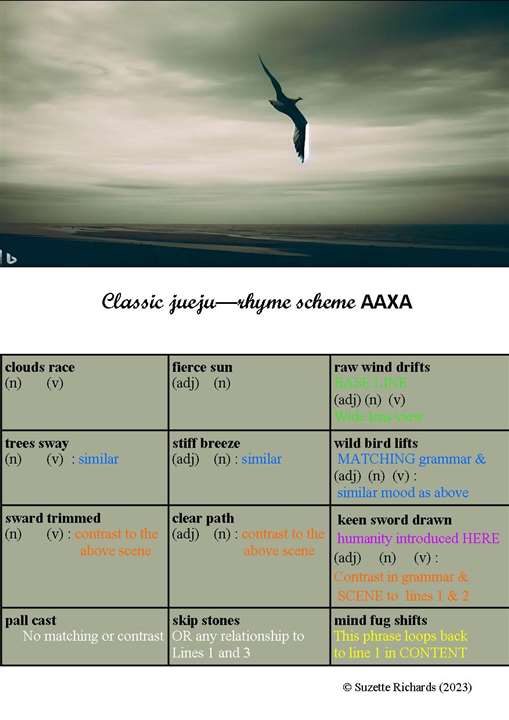
Consider this rule-based jueju, written three years ago, which follows the AAXA rhyme scheme and honours the structure, tonal harmony, and parallelism of the form. Using imagery in an imaginative way, it incorporates symbolism to lend balance to the poem as a whole:
clouds race / fierce sun / raw wind drifts
trees sway / stiff breeze / wild bird lifts
sward trimmed / clear path / keen sword drawn
pall cast / skip stones / mind fug shifts
© Suzette Richards (2023)
Each line builds in parallel, balancing nature’s movement with human presence. The rhyme break in the third line introduces tension, while the final line turns inward, shifting from external imagery to inner reflection. The clipped phrasing and absence of punctuation heighten the pared-down intensity, showing how jueju thrives on precision yet leaves room for resonance beyond the words themselves. Here, the sword is not only a weapon but a symbol of inner struggle, while the pall suggests the shadow of mortality. Such symbolism lends balance and depth to the poem beyond its surface imagery.

The beauty of jueju poetry is that one can't fake it—it is poetry written with your heart on your sleeve.
The Inevitability Factor
You can’t coax a jueju into being with clever phrasing alone; the form insists that the poet’s heart be laid bare in those four compressed lines. If the final line doesn’t carry that emotional aftershock, the whole piece falters, no matter how polished the imagery leading up to it.
That’s why even the most technically precise imitations often feel hollow—they can echo the structure, but they rarely summon the raw honesty that makes a jueju resonate. The form is demanding, but that’s its gift: when it succeeds, it feels inevitable, as though the poem had always been waiting, and you simply uncovered it.
My mantra has always been that if a poem does not move you, it will not move anyone else. With jueju, this is even more true. Its brevity leaves no space for artifice—the poet’s heart must be present, or the resonance is lost.
Conclusion
In a world where attention is fleeting and words often blur into noise, the jueju offers a refreshing reminder of poetry’s essence: clarity, brevity, resonance. Its ancient constraints invite modern poets to refine thought, sharpen imagery, and let silence echo as profoundly as sound. One must sit with it—absorb the moment, surrender to the final phrase. Across centuries and cultures, the jueju endures, a small poem with a vast heart, carrying its quiet power forward
.EXAMPLE POEM
flying kites | Poem (poetrysoup.com)
CONTEST WINNERS: Life’s about choices (March 2026)
- autumn | Poem (poetrysoup.com)
- Spring | Poem (poetrysoup.com)
- fall | Poem (poetrysoup.com)
In my contest, I have relaxed the monosyllabic rule to allow for clarity. By easing this restriction, I gave poets room to experiment without feeling constrained by technicalities. The three-syllable closing reflection, however, remains non-negotiable, as it is the heart of the jueju form. Allowances are made for a preceding linking word—for example, conjunctions such as but, because, thus, or and—such a word still sets up the characteristic caesura (pause) and normal grammar will determine whether it is read together with the final syllables or not.
References:
Jueju - Wikipedia
Newman Prize for English Jueju (ou.edu)
American professor shares Chinese classical poetry with English speakers_Expat Stories (shanghai.gov.cn)
Jonathan Stalling on “Spring Snow” – Poetry Daily (poems.com)