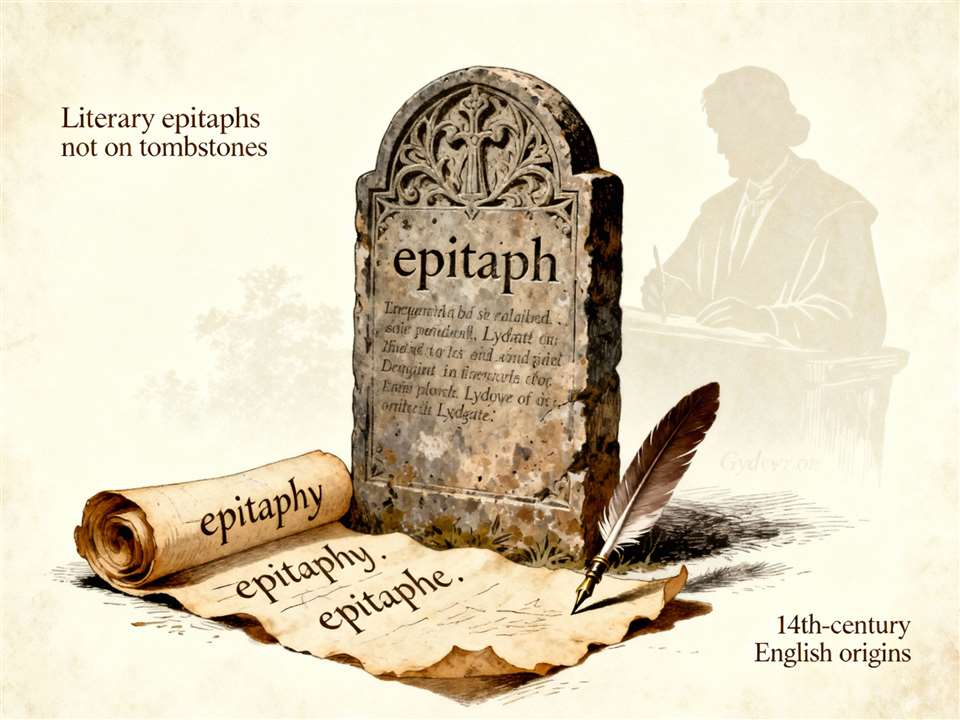
An epitaph is essentially an inscription on a tomb, though the term has evolved to refer to any text intended for that purpose, whether or not it is actually inscribed on a gravestone. When the word entered the English language in the 14th century, it appeared as both "epitaphy" and "epitaphe," with the latter used by writers like Gower and Lydgate. Many well-known epitaphs throughout history are literary pieces that don't actually appear on tombstones. Sometimes, the author may have intended for their words to be placed on a grave but that plan never came to fruition; other times, there may have been no intention for that at all. Regardless, if the writing is appropriate for a tomb, it qualifies as an epitaph, even if it isn't used as one.
The human desire to honor the memories of the deceased is universal, which is why the practice of placing epitaphs on graves has persisted across cultures and epochs. It's fascinating to see how similar thoughts and expressions appear in epitaphs from over 2,000 years ago compared to those written today. For example, the poignant sentiments of a Roman mother in the lines—
“Lagge fili bene quiescas;
Mater tua rogat te,
Ut me ad te recipias:
Vale!”
— can still be found echoing in modern cemeteries.
The oldest known epitaphs come from ancient Egypt, inscribed on sarcophagi and coffins, and they typically begin with prayers to deities like Osiris or Anubis for the deceased. These inscriptions usually specify the person's name, family background, and role, but they lack a personal touch and only express the emotions of the living through the act of prayer.
In contrast, ancient Greek epitaphs possess significant literary value, often rich in feeling and more expressive in language, frequently written in elegiac verse, though many of the later ones are in prose. Notably, many well-known Greek epitaphs celebrate those who died in battle, including some attributed to Simonides, such as the famous lines:
“Go tell the Spartans, thou that passest by,
That here, obedient to their laws, we lie.”
In Sparta, epitaphs were reserved for those who displayed exceptional bravery in war, while in Athens, they were more broadly applied. They typically included the person's name, ancestry, date of death, and a summary of their life. However, many so-called Greek epitaphs are literary creations not meant for actual memorial use, allowing for wider reflections rather than strict biographies. Some, like the one attributed to Plato, focus on more philosophical themes:
“I am a shipwrecked sailor’s tomb; a peasant’s there doth stand:
Thus the same world of Hades lies beneath both sea and land.”
Others may lack any personal details entirely, leaning more towards general thoughts on death rather than specific individuals.
Roman epitaphs were generally straightforward compared to their Greek counterparts, typically just stating facts. The inscriptions found on urns, many of which are displayed in the British Museum, follow a consistent format. They usually start with the letters D.M. or D.M.S. (which stand for Diis Manibus or Diis Manibus Sacrum), followed by the name of the deceased, their age at death, and occasionally a few additional details. The inscription usually ends with the name of the person who commissioned the urn and their relationship to the deceased.
Interestingly, the letters D.M. appear even on some early Christian inscriptions in the catacombs, suggesting a lingering connection to older beliefs. Some argue that in these cases D.M. could mean Deo Maximo instead of Diis Manibus, but that interpretation is not widely accepted, especially given the evidence of pagan influences still present in early Christian practices. The catacomb inscriptions themselves provide numerous examples of the blending of pagan and Christian elements.
Most private burial sites for ashes were located along main roads leading into Rome, like the Via Appia and the Via Flaminia. Travelers would pass by many tombstones, often beginning their inscriptions with phrases such as "Siste Viator" or "Aspice Viator," reminiscent of the modern-day "Stop Passenger" signs found in churchyards across Britain. Another commonly seen phrase, "Sit tibi terra levis," meaning "Light lie the earth upon you," has carried on into modern use.
Many Roman tombstones featured strong warnings against disturbing the grave, and similar sentiments have appeared throughout history. A well-known example is the inscription on Shakespeare’s tomb in Stratford-upon-Avon, which reads:
Good friend, for Jesus’ sake forbear
To dig the dust enclosed here;
Blessed be the man that spares these stones,
And cursed be he that moves my bones.
The oldest British epitaphs come from the Roman period and are written in Latin, mirroring Roman customs. Examples can be found in various museums across the country, including those mentioned in Bruce’s “Roman Wall” and the seventh volume of the Corpus Inscriptionum Latinarum, edited by Hübner, which catalogs British inscriptions. The earliest epitaphs usually commemorate soldiers from the occupying legions, but the Roman style was later adopted by local Britons.
Even after the Roman style faded, Latin remained the primary language for public inscriptions because of its perceived durability for communicating through the ages. Only in recent years has the use of Latin for epitaphs declined, with a shift toward writing them in the local language of the country where the individual lived. Up until the 11th and 12th centuries, most surviving English epitaphs are in Latin and typically only state the name and rank of the deceased, starting with the words "Hic jacet" (Here lies).
However, there are a couple of notable exceptions where epitaphs are more elaborate. One is for Gundrada, daughter of William the Conqueror (d. 1085), which still exists in a damaged form at Lewes. Another is for William de Warren, the earl of Surrey (d. 1089), believed to have been inscribed in St. Pancras Abbey, which he founded. Both of these inscriptions are more comprehensive and beautifully express the character and achievements of the deceased.
By the 13th century, French began to replace Latin for epitaphs, particularly for notable historical figures between 1200 and 1400. Examples include inscriptions for Robert, the 3rd earl of Oxford (d. 1221), Henry III (d. 1272) at Westminster Abbey, and Edward the Black Prince (d. 1376) at Canterbury. In many of these inscriptions, the deceased speaks directly to the reader, detailing their status in life while contrasting it with their current grave state, often ending with a cautionary reminder for the reader to prepare for their own inevitable fate—
Bonys emongg stonys lys ful
steyl gwylste the sawle wan-
deris were that God wylethe
— that is, Bones among stones lie full still, whilst the soul wanders whither God willeth. It may be noted here that the majority of the inscriptions, Latin and English, from 1300 to the period of the Reformation, that have been preserved, are upon brasses (see Brasses, Monumental). The very curious epitaph on St Bernard, probably written by a monk of Clairvaux, has the peculiarity of being a dialogue in Latin verse.
It was during Queen Elizabeth's reign that epitaphs in English began to take on a unique literary style and significance, allowing them to stand alongside those previously written in Latin. Nash tells us that by the end of the 16th century, writing English verse epitaphs had become a trade. One notable example is the epitaph for the dowager countess of Pembroke (d. 1621), written by William Browne, known for his work *Britannia’s Pastorals*:
Underneath this dark hearse
Lies the subject of all verse;
Sydney’s sister, Pembroke’s mother;
Death, before you take another
Fair, learned, and good like she,
Time will aim its dart at thee.
No marble stones should men erect
To her name for future respect;
Some kind woman, born like she,
Reading this, like Niobe,
Will turn to stone and become
Both her mourner and her tomb.
While the second stanza might seem a bit exaggerated, it’s clear that epitaphs, like all forms of writing, reflect the literary traits of their time. The rejection of marble as unnecessary leads to one of the greatest literary epitaphs in English, written by Milton for Shakespeare.
Pope's epitaphs are still regarded as having significant literary value, though their appreciation has waned since the time of Samuel Johnson and other critics who valued them more highly. Johnson, an expert on both the theory and practice of epitaph writing, penned an essay on the subject, making his views on the use of Latin quite influential. When several distinguished individuals suggested that English should be used for Oliver Goldsmith's epitaph, his response was notable and demonstrated his firm belief. His arguments in favor of Latin primarily emphasized its suitability for epitaphs and its lasting nature. While it's true that Latin fits the purpose very well, its relevance has shifted since Johnson’s era. For most educated individuals today, Latin is not part of daily communication, making it increasingly impractical to write epitaphs in a language that many can’t understand.
Despite his preference for Latin, Johnson composed beautiful English epitaphs, such as the one for the musician Philips:
Philips, whose harmonious touch could ease
The pains of guilt or love’s miseries;
Rest here, troubled by poverty no more,
Here find the calm you gave us so often before;
Sleep undisturbed within this peaceful space
Until angels wake you with a note like yours!
Epitaphs can be categorized in various ways. Organizing them by nationality might show less clear distinctions of race compared to other literature, because in moments of deep emotion, people express themselves similarly, regardless of their country. Yet, some national influences can be observed. The elegance and wit of French epitaphs, for instance, are evident. In the 16th century, the epitaphs of Étienne Pasquier were widely praised. Examples include “La première au rendez-vous,” carved on a mother’s grave, as well as Piron’s self-penned epitaph after being rejected by the French Academy:
Here lies Piron, who was nothing,
Not even an academicien.
Another memorable inscription by a pleased husband at Père la Chaise reads:
Here lies my wife. How happy she is
For her rest and for mine.
You can easily find that English epitaphs capture a much wider range of thoughts and feelings than those of any other nation, moving from the deeply moving to the simply mundane, showing the complex nature of English nationality.
Epitaphs can also be sorted by their authors or subjects, but a more interesting division highlights their unique features. This variety mentioned about English epitaphs applies more broadly to epitaphs in general, showcasing the spectrum of human sentiment.