From their earliest appearances in ancient Greek and Hebrew texts—most memorably in the Psalms and Lamentations, where successive verses follow the Hebrew alphabet—acrostics have carried meaning beyond mere ornament. They illuminate themes, restore the bond between words and ideas, and demand pattern recognition, sequencing, and flexible reasoning. In our own time, they reclaim creativity against the flattening effect of machine-generated literature, and their puzzle-like design even serves in rehabilitating patients with cognitive disabilities. Across centuries, the acrostic remains both a vessel of tradition and a living exercise in human ingenuity.
The abecedarian is inseparable from the alphabet acrostic tradition, where sacred texts and later poems used sequential letters as a structuring device. Its evolution shows a shift from mnemonic teaching to literary artistry, and finally to a general metaphor for beginners or alphabetical order.
The word abecedarian comes from Medieval Latin abecedarius, meaning ‘ABC primer’, formed from the first four letters of the alphabet (a+b+c+d) plus the suffix -arius.
Example Abecedarian: A Cut above the Rest | Poem (poetrysoup.com)
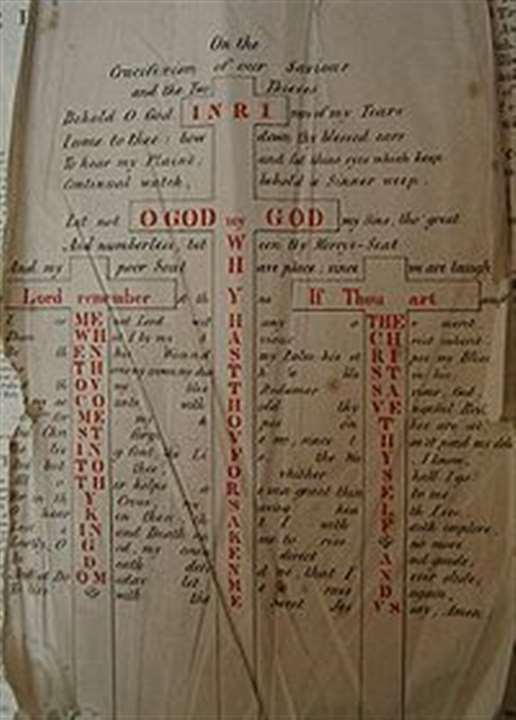
Triple acrostic by Sir Thomas Browne.
Acrostics in General
An acrostic is usually used to point out something of wider importance or to emphasise an underlying theme. Historically, the acrostic poem conveyed secret or concealed messages to the audience or the intended recipient. The intent of the acrostic is to reveal while attempting to conceal within the poem or script.
In early Christian manuscripts, scribes sometimes embedded hidden messages which were ordinarily forbidden and/or wove their names into the scripts. Some had elevated it to an art form, often arranged in symbolic shapes like a cross such as the example depicted above by the English polymath, Sir Thomas Browne (1605–1682). Browne’s work is a brilliant Renaissance/Baroque demonstration of how the form could be pushed to extremes. It’s a reminder that acrostics weren’t just mnemonic devices—they could also be feats of intellectual artistry.
Guidelines for Acrostics
Purpose: Acrostics can be playful, commemorative, didactic, or cryptic. They often serve as puzzles, tributes, or mnemonic devices.
- Core definition: An acrostic is a poem in which certain letters, words or even syllables (most often the first in each line) spell out a word, phrase, or message when read vertically. It might also be read from the bottom up (anacrostic), or be on the diagonal, etc—in other words: in any discernible pattern..
EXAMPLE: Just Desserts | Poem (poetrysoup.com)
- Flexibility of form:
- It may be rhymed or unrhymed.
- It may follow a metre or be free verse.
- The defining feature is the hidden word/message, not the rhythm or rhyme scheme.
- Straddling: The words in a multi-word acrostic solution do not necessarily have to be defined in separate stanzas. The ‘hidden clue’ can stretch across lines continuously, even if it contains spaces.
- Line endings & punctuation: Entirely at the poet’s discretion. Acrostics can be punctuated like prose or left open-ended.
- Length: Determined by the length of the word or phrase being spelled. Each letter typically requires its own line, but it allows for enjambment where it lines up with the message being spelled out. See my example poem above: L5 & L6.
- Titles: Optional. Some poets use the acrostic word itself as the title, others choose a separate title.
- Poetic devices: Imagery, metaphor, alliteration, enjambment, irony, etc can be freely employed to enrich the poem.
- Variations:
- Telestich: last letters of each line spell the word.
- Mesostich: middle letters spell the word. What John Cage later popularised as the mesostic.
- Double acrostic: both first and last letters spell words.
- Alphabetical acrostic (abecedarian): Using the full alphabet, each line begins with successive letters of the alphabet
- ABC poem (an abecedarian variant): where only part of the alphabet is used, commensing anywhere. It has 5 lines that create a mood, picture, or feeling. Lines 1 through 4 are made up of words, phrases, or clauses—and the first word of each line follows alphabetical order. Line 5 is one sentence, beginning with any letter.
- Anacrostic: Instead of spelling the word in the usual forward order, the letters appear backwards (from bottom to top, or end to beginning). So if an acrostic spells LOVE, an anacrostic would spell EVOL.
- Diagonal acrostic: the letters appear progressively diagonally down the page.
- Vertical Monocrostic: Only one word per line is used to spell out the solution (first letter each) and presented vertically on the written page.
- Name: It is a poem that uses the first letter of each line in the poem to tell us in phrases or clauses about the person, pet, etc, whose name forms the poem’s title.
- Non-standard acrostic poem: This is when there is no single line of letters that forms a word or phrase. Rather the letters and/or words are distributed randomly throughout the poem or text. They are usually emphasised in some way so that a reader will know to look for them, for example, using drop caps, colour coded, or per a prearranged encrypted code which provides the cipher that unlocks the message.
Poem Analysis (literary resource) lists ‘non-standard acrostic’ alongside other acrostic types (double acrostic, telestich, mesostich). It describes acrostics broadly and acknowledges variations beyond the traditional vertical form.
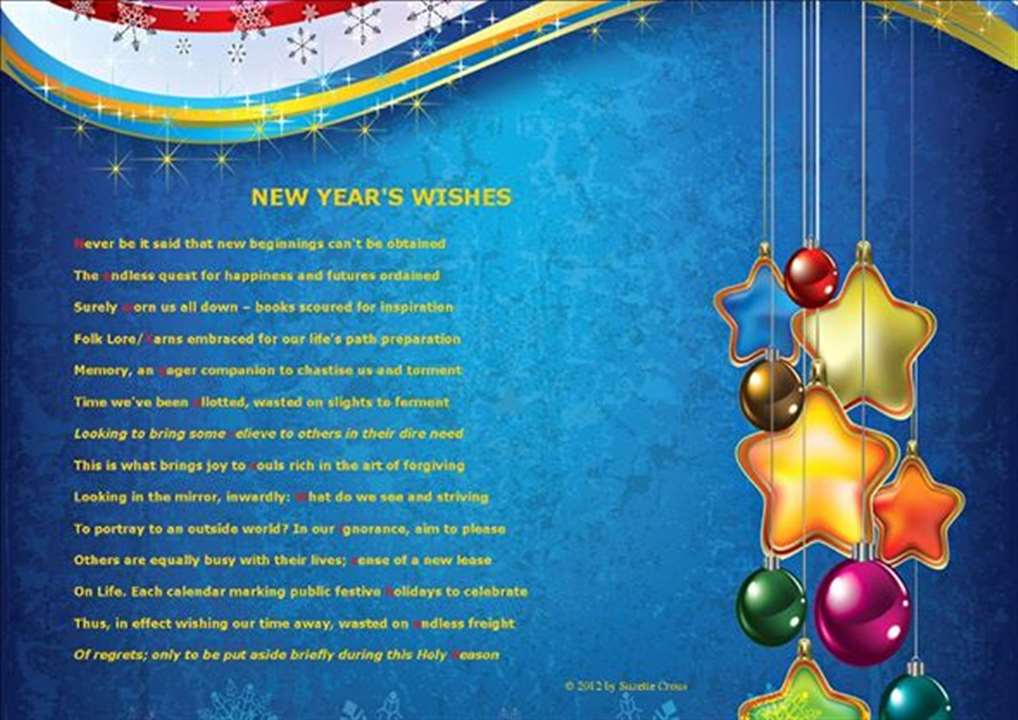
An acrostic on the diagonal.
Non-standard Acrostics
Acrostics are more than mere hidden messages—they require a level of forethought and linguistic skill.
Code Whisperer
We are concentrating on the non-standard acrostic with its prearranged encrypted code as mentioned above—the key to unlock it is build into the title of the poem or a prose vignette. The aim of this form of acrostic is to mock conceal the message, but it is ultimately transcribed in the footonote. The name was coined to differentiate it from other forms of acrostic poetry.
Tip: Use a key that will result in multiple words scattered across the text and not lengthy phrases—where is the fun in that? Seeing as the text acts as the vehicle for your ‘hidden massage’, make every word count—don’t waste your word limit for the succinct encrypted message on unnecessary filler words such as articles (a, an, the).
Code Whisperer Starter Kit
- Recurring features: Use thematic vocabulary (rivers, sport, hobbies, malapropisms). Example: Acrostic Baking—‘A PINCH of salt’ becomes ‘at A PINCH’ in the decoded message.
- Chameleon words: Homographs, homonyms, auto-antonyms. Words spelled the same but shifting meaning once decoded. Even modifiers can morph through conversion (eg, run as noun vs verb).*
- Spelling/grammar keys: Choose one aspect only. Corrected spellings reveal the hidden message: it’s → its, dairy → diary, cite → sight → site. Don’t mix categories.
- Archaic/etymology: Words whose meanings changed over time. Example: awful once meant ‘worthy of awe’. Modern shifts like unique (from ‘one of a kind’ to ‘very unusual’) can encode subtle messages.
- Second language borrowings: Trace origins and shifts: ambience → ambiance, kilo- from Greek chilioi, or Afrikaans gatvol now in Oxford (2025). These linguistic journeys can conceal layered codes.
- Numerical clues: Example: Acrostic Prime—read words at prime positions (2, 3, 5, 7, 11, 13…). Remember: 9 is not prime! Titles like Baker’s Dozen signal positional keys (read every 13th word in the text).
- Decoys: Rhetorical devices (alliteration, sibilance, rhyme) can distract, but the true key must be singular and clear. Decoys add texture without overshadowing the hidden message.
In the following example I used alliteration in the first line and final line as decoys. The words adhering to the sibilance ‘rules’ are in caps in the poem for ease of reference.†
- Decoded message: I adjusted grammar for clarity, and even the meaning of the original words may change (typical of an encoded message), eg, branches could now refer to offices; sweeping may now refer to being swept for bugs (listening devices), etc. Punctuation was adjusted for clarity.‡
- The key to decipher it is contained in the title.
ACROSTIC SIBILANCE
The fog blanketed the broad-leafed bracken.
In the deep, FRESH STRANGE SCENT of florae beckon;
the BRANCHES SWEEPING the rocky outcrop.
SO, by STEPPING lightly and SWIFT drop,
from giddy panoramic view I’m torn:
Never to tarry too long at the tarn.
Decoded message: Fresh, strange scent – branches swept, so step swiftly.
Don’t mix and match the keys—it should be straightforward enough to apply to the text. These are just a few ideas, but I encourage you to come up with your own unique formula for the encrypted messages which should have some semblance of a secret communication. The sky is the limit when you tap into the human spirit—playful or earmarked for a serious endeavour.
Objective: Pattern recognition and human inventiveness
As poet and author, you have the dual roles of cryptographer and cryptanalysts.
Akin to Code Whisperer
The invented form, ™Phoenix sixain,** is akin in concept to the Code Whisperer. The poet selects five random words from five consecutive lines in the designated work, and reframes these into a sixth line to create a whole new poem offering fresh perspective. The effect is regeneration—like a phoenix, the poem is reborn from its own ashes.
EXAMPLE
The 5-line verse is from my poem, Where do Birds Go when they Die? (2014). It first appeared in the book, The Eutony of Words, by Suzette Richards (2018).
A Woman’s Longing
trailing her fingers through the crystal water
momentarily leaving a disturbance
soon to return to a calm mirror
believing woman’s love to be brief
driven mad by the longing and grief
water momentarily return woman’s longing
© Suzette Richards 12/22/2024
A tarn - image generated
™Suzcrostic (May 2016)
This poetic form was inspired by the acrostic, but I took it to the next level by incorporating poetic devices such as rhyme and set stanzas which lend a cadence and depth to the poem. The poem does not aim to conceal as the title is upfront. The quatrains elaborate upon the mono-rhymed lines and move the poem forward in a logical fashion.
- The first lines of these stanzas are in mono-rhyme; followed by:
- a quatrain that elaborates upon the preceding mono-rhymed line and is presented indented below it. Metre is optional.
- Rhyme scheme: abcbc; adede; etc, (‘a’ being the mono-rhyme—NOT a refrain).
The number of stanzas would be dictated by the number of lines required to convey the message.
It was listed at PoetrySoup.com as a new poetic form on 1 July 2021. See under Example at the following page link:
New Poetic Forms | Invented Forms of Poetry (poetrysoup.com)
THE HOPE
THE flame burns with your name.
A broken dawn still aches with stains
yet morning hums through fractured bars.
The pulse of hope, though faint, remains,
and threads of light stitch healing stars.
HOPE doused the searing flame.
The roots of courage burrow, fall
through soil of sorrow; loss of sleep.
The forest bends, the river calls,
and trust awakens from its keep.
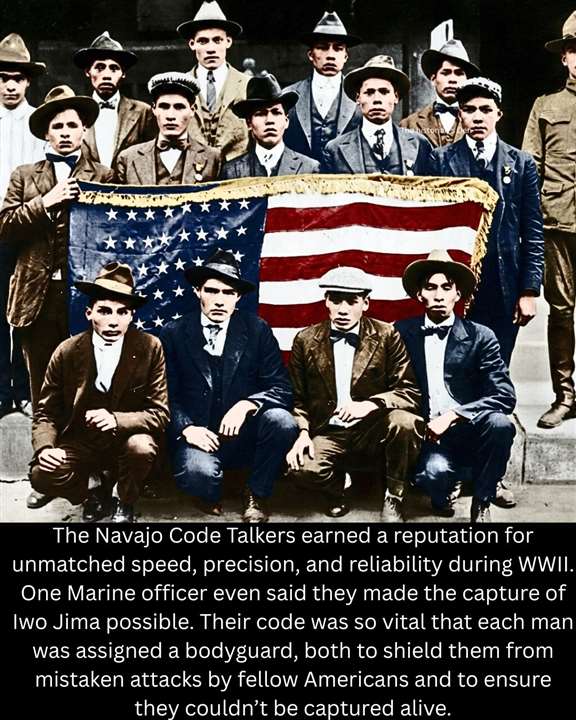
The famous WWII code breakers were known simply as code breakers or cryptanalysts, with the most famous group working at Bletchley Park in Britain. Key figures included Alan Turing, Gordon Welchman, Dilly Knox, and Elizebeth Smith Friedman. There were also the lesser known Windtalkers††—the Navajo cryptologists during WWII. This was the inspiration behind the unique name, Code Whisperer.
Cognitive Rehabilitation through Puzzles
Word puzzles like acrostics, crosswords, and even jigsaws all share a key benefit: they demand pattern recognition, sequencing, and flexible reasoning. Those are exactly the cognitive skills that can feel dulled after illness or injury, and exercising them helps the brain re-establish speed and resilience.
Why acrostics can aid recovery
- Pattern recognition: Spotting hidden words vertically or diagonally forces the brain to scan differently than normal reading.
- Sequential reasoning: Following alphabetic or word order (like in abecedarians or ABC poems) strengthens working memory.
- Creative flexibility: Acrostics combine logic with imagination, engaging both hemispheres of the brain.
- Reward loop: The ‘aha!’ moment of solving a hidden word releases dopamine, reinforcing motivation and recovery.
Conclusion
An acrostic is more than a clever device—whether written as a personal challenge or to entertain the reader—it is timeless in its appeal.
*Does Poetry Benefit by Incorporating Modifiers? (poetrysoup.com)
†Enhancing Rhythm and Mood in Poetry | PoetrySoup.com
††The Navajo Code Talkers, often called ‘Windtalkers’, were US Marines who used their language to create an unbreakable code in the Pacific theatre. Their work remained classified until 1968, but today they are recognised as one of the most effective cryptographic teams in history. In a ceremony on 26 July 2001, President George W Bush presented the Congressional Gold Medal to the original 29 Navajo Code Talkers, with Silver Medals awarded to later recruits.
[Edited and updated: 13/6/2026]