Home »
Poetry » Meter and Foot in Poetry
Meter and Foot in Poetry
Meter and foot are two of the most important building blocks of poetry. They determine the rhythm, musicality, and flow of a poem by organizing patterns of stressed and unstressed syllables. Understanding poetic meter helps readers appreciate how a poem sounds when spoken aloud and gives writers greater control over pacing, emphasis, and emotional impact.
A foot is the basic rhythmic unit of poetry, made up of a specific arrangement of stressed and unstressed syllables. A meter is created by repeating those feet throughout a line of verse. Different combinations produce familiar rhythmic patterns such as iambic, trochaic, anapestic, and dactylic meter.
One of the best-known examples comes from Shakespeare:
No longer mourn for me when I am dead.
Read aloud, the line follows the rhythm:
bah-BAH bah-BAH bah-BAH bah-BAH bah-BAH
or:
no LON-ger MOURN for ME when I am DEAD.
Each iamb consists of one unstressed syllable followed by one stressed syllable. Five iambs form iambic pentameter, the most famous meter in English poetry and the dominant rhythm used by Shakespeare in his plays and sonnets.
Learning the different types of poetic feet and meters allows poets to create everything from gentle, flowing verses to energetic, dramatic, or even playful rhythms. Whether you're studying classic literature or writing your own poems, understanding meter is an essential step toward mastering the craft of poetry.
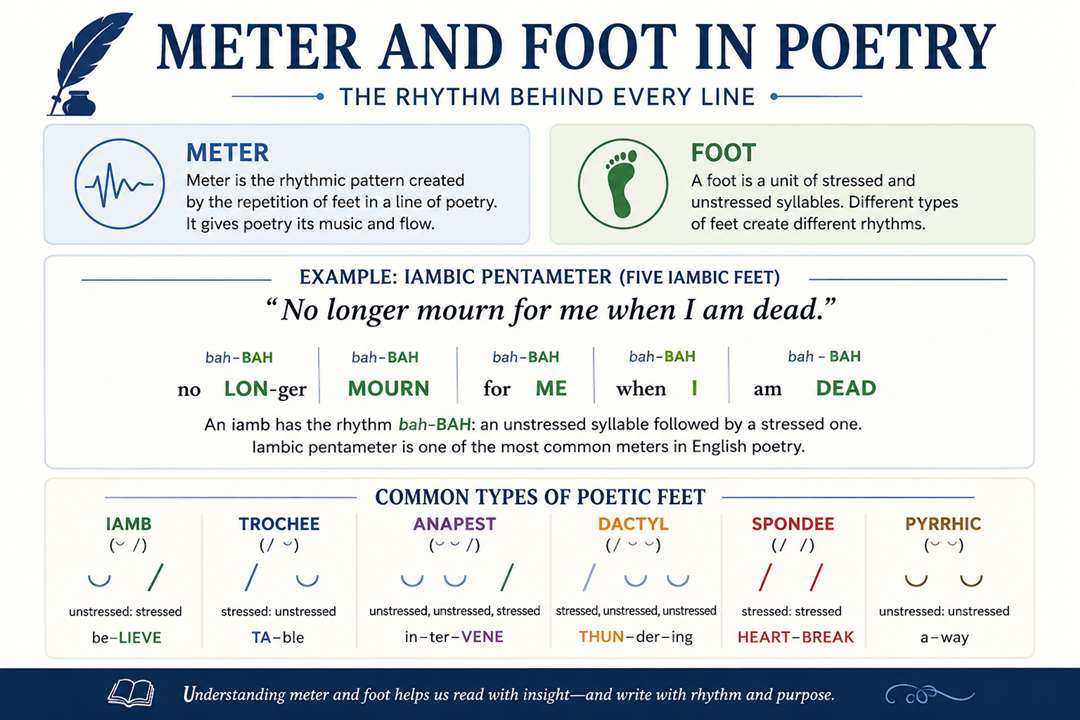
Please note that the templates above almost never fit an actual poem exactly. If we use this foot-based method to describe poetic meter in English, we have to allow for abundant "substitution," where any iamb ( * / ) can become a trochee ( / * ), a spondee ( / / ), or a pyrrhic ( * * ). Trochaic rhythm tends to be somewhat more regular, but substitutions occur there as well. Sometimes poets introduce three-syllable feet into a line of iambs or trochees, and three-syllable (or "triple") footed meters often shift from anapests ( * * /), to dactyls ( / * * ), amphibrachs ( * / * ), amphimacers ( / * / ), and other combinations.
Note that spondaic meters or pyrrhic meters (as opposed to individual feet) in English are impossible because of the constant alternation of stressed and unstressed syllables. Despite this obvious truth, some discussions of English metrics speak of spondaic meter and even attempt to illustrate it with lines isolated from poems written in iambic or anapestic meters.