The Paradelle is a fixed-form poem that was introduced by Billy Collins, a former United States Poet Laureate. Collins created the form in 1997 as a playful parody of highly structured poetic forms such as the villanelle and sestina. Despite its humorous origins, many poets have embraced the Paradelle as a legitimate challenge that demands precision, creativity, and careful attention to language.
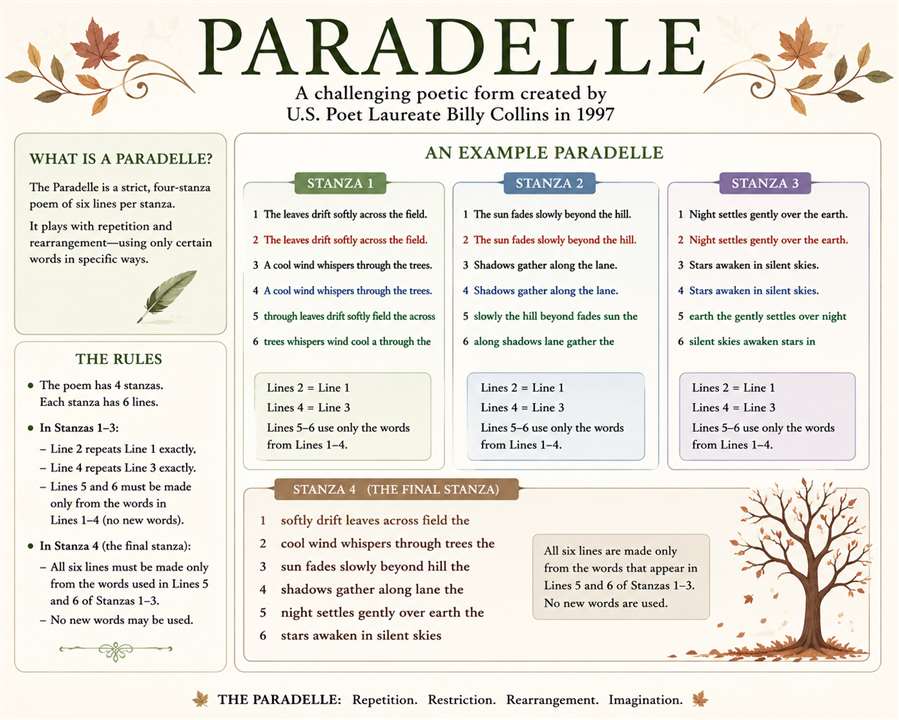
A traditional Paradelle consists of four six-line stanzas. In the first three stanzas, the first line is repeated exactly as the second line, and the third line is repeated exactly as the fourth line. The fifth and sixth lines of each stanza must be composed entirely of the words used in the first four lines, with no new words added.
The fourth and final stanza serves as a conclusion and is made up of six lines created from all of the words used in the fifth and sixth lines of the previous three stanzas. Again, no new words may be introduced. This intricate structure requires poets to carefully rearrange existing language while still creating meaning, imagery, and flow.
Because of its strict rules and word-recycling requirements, the Paradelle is considered one of the most challenging modern poetic forms. It combines repetition, wordplay, and inventive expression, making it a favorite among poets who enjoy formal constraints and linguistic puzzles.
Structure
-
Stanza 1: Six lines. Line 2 repeats Line 1 exactly, and Line 4 repeats Line 3 exactly. Lines 5 and 6 must be created entirely from the words used in Lines 1–4, with no new words added.
-
Stanza 2: Six lines. Follow the same pattern as Stanza 1: Line 2 repeats Line 1, Line 4 repeats Line 3, and Lines 5 and 6 are made only from the words appearing in Lines 1–4.
-
Stanza 3: Six lines. Again, Line 2 repeats Line 1 exactly, Line 4 repeats Line 3 exactly, and Lines 5 and 6 must be composed solely of words from the first four lines of the stanza.
-
Stanza 4 (Final Stanza): Six lines. All six lines must be created using only the words that appeared in Lines 5 and 6 of the previous three stanzas. No new words may be introduced.
Example
Autumn Evening
The leaves drift softly across the field.
The leaves drift softly across the field.
A cool wind whispers through the trees.
A cool wind whispers through the trees.
through leaves drift softly field the across
trees whispers wind cool a through the
The sun fades slowly beyond the hill.
The sun fades slowly beyond the hill.
Shadows gather along the lane.
Shadows gather along the lane.
slowly the hill beyond fades sun the
along shadows lane gather the
Night settles gently over the earth.
Night settles gently over the earth.
Stars awaken in silent skies.
Stars awaken in silent skies.
earth the gently settles over night
silent skies awaken stars in
softly drift leaves across field the
cool wind whispers through trees the
sun fades slowly beyond hill the
shadows gather along lane the
night settles gently over earth the
stars awaken in silent skies