Poetry and astrology may seem to belong to completely different worlds. One is built from words, rhythm, metaphor, and imagination; the other from planets, signs, houses, and symbolic interpretations.
Yet both begin with a remarkably similar question:
How can something outside ourselves help us describe what is happening inside?
A poet might look at the moon and see loneliness, renewal, or memory. An astrologer might interpret the Moon as a symbol of emotional life. Neither approach requires the moon to literally explain a person's feelings. The power is in the meaning we attach to it.
This is where astrology becomes unexpectedly interesting for anyone fascinated by poetry and the art of self-expression.
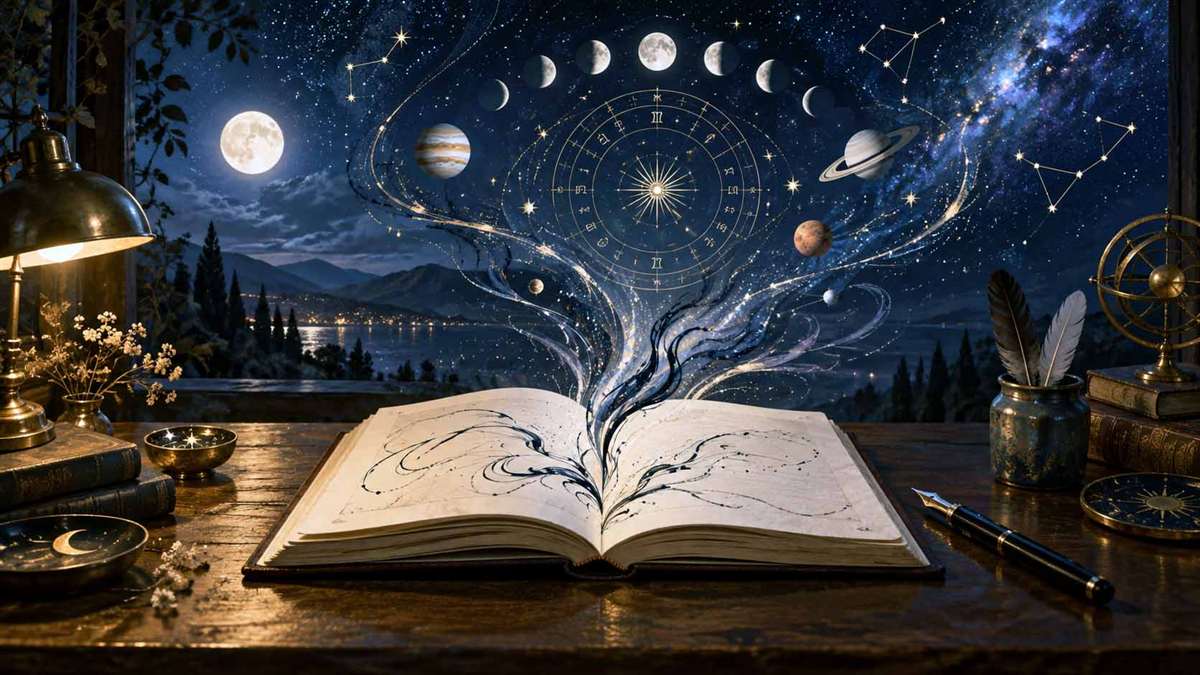
A Natal Chart Is a Poem Written in Another Alphabet
A poem compresses an enormous amount of experience into a small number of carefully chosen images.
A natal chart does something surprisingly similar.
Instead of words, it uses a symbolic vocabulary of planets, signs, houses, and aspects. Each element can become a starting point for reflection. The result is not a conventional biography, but something closer to a symbolic portrait.
Consider the difference between these two descriptions:
“You are an emotional person.”
It is straightforward, but not particularly memorable.
Now imagine describing someone's emotional world through imagery: tides, hidden rooms, changing seasons, distant horizons. Suddenly, the same psychological idea becomes something a person can explore.
Symbolism creates space for interpretation.
Why Metaphors Can Reveal Unexpected Things
Metaphors work because they allow us to approach familiar experiences from an unfamiliar direction.
Someone who has always thought of themselves as “too sensitive” might encounter a different metaphor and begin thinking about sensitivity as perception rather than weakness. Someone who considers themselves indecisive might start questioning whether they are actually trying to preserve too many possibilities at once.
Astrological symbolism can perform a similar function.
The interpretation itself may be subjective, but the questions it generates can be surprisingly personal.
Writing Yourself Through the Language of the Stars
One fascinating exercise is to treat a natal chart as a prompt for creative writing.
Instead of asking, “What does my chart predict?”, try asking:
- What character would my chart describe?
- What would this character fear losing?
- What kind of relationship would transform them?
- What contradiction would define them?
- What part of their story remains unfinished?
The answers do not need to be “astrological.” They can become the raw material for a poem, journal entry, short story, or personal reflection.
In that sense, astrology becomes less about predicting events and more about generating creative questions.
Where HintApp Fits Into This Idea
Modern astrology platforms make this symbolic exploration considerably more accessible.
HintApp, for example, brings together natal charts, horoscopes, compatibility, and relationship-oriented astrology in a digital environment. For someone interested in self-reflection, the attraction is not necessarily the promise of discovering an absolute answer about the future.
It can simply be the opportunity to see familiar aspects of life through another symbolic framework.
A Reddit discussion containing a HintApp illustrates another interesting aspect of digital astrology: people naturally compare interpretations with their own experiences. The resulting conversation becomes almost literary — one person describes an interpretation, another recognizes something familiar, and a third sees it completely differently.
That disagreement is not necessarily a weakness.
It is exactly what makes symbolism interesting.
The Poet and the Astrologer Ask Similar Questions
There is a useful distinction between telling someone who they are and giving them a language with which to explore who they might be.
Great poetry rarely says, “Here is the one correct interpretation of this emotion.” Instead, it creates an image and allows the reader to enter it.
Astrology can be approached in much the same way.
|
Poetry
|
Astrology
|
|
Metaphor
|
Symbol
|
|
Imagery
|
Planetary archetype
|
|
Rhythm
|
Cycles
|
|
Speaker
|
Natal chart
|
|
Interpretation
|
Personal reflection
|
|
Open ending
|
Multiple possible meanings
|
Neither requires the reader to accept a single interpretation.
From Horoscope to Personal Mythology
There is another intriguing connection between astrology and poetry: both can help people construct a personal mythology.
Everyone carries stories about themselves.
“I am the responsible one.”
“I always fall for unavailable people.”
“I was never good at expressing myself.”
“I have to be strong.”
These stories may once have been useful, but they can eventually become restrictive.
Symbolic thinking gives us permission to rewrite them.
A natal chart can become a prompt for examining an old identity rather than a sentence defining a permanent one. A poem can do exactly the same thing. Both can turn an unquestioned personal story into something visible — and therefore something that can potentially be changed.
The Most Interesting Interpretation Is Still Your Own
Astrology should not be confused with scientifically established prediction, and no chart can replace personal judgment or real-world experience. But symbolism does not have to be scientifically predictive to be creatively useful.
Sometimes a metaphor is valuable precisely because it makes us pause.
A line of poetry can change the way we remember an experience. An astrological symbol can change the question we ask about ourselves.
And perhaps that is the most unexpected connection between poetry and the stars: neither has to tell us exactly who we are.
They can simply give us better words — or better symbols — for discovering who we might become.