This collection brings together every major type of rhyme with clear definitions—an all-in-one resource you won’t find gathered under a single umbrella anywhere else.
Rhyme is simply the similarity of sounds between words, especially in poetry. Different kinds of sound-matches create different types of rhyme. When these rhymes follow a planned pattern, that pattern is called a rhyme scheme.
In a rhyming poem, the same or similar sounds repeat—usually at the ends of lines. For example, in a four-line stanza (a quatrain), a common rhyme scheme is abab, where the first and third lines rhyme, and the second and fourth lines rhyme.
A poem with rhyme can have many stanzas, and it doesn’t have to follow a regular beat or metre.

Precision and balance in the pursuit of harmony.
How Elision Typically Worked in Older English Poetry
Where the poet needed to adjust the syllable count or grammar, they often elided a word and used an apostrophe to indicate it (cent‘ries for centuries). It is to omit (a sound or syllable) when speaking.
The choice depended on the dialectal flavour the poet wanted and the metrical need. The vowel would be dropped entirely, for example, bar’n or b’ring (the latter was less common, but possible depending on metre). Poets used this when they needed to compress a syllable to fit a metrical line, for example, barin’ or bar’n. This was extremely common in 17th–19th-century verse—Burns, Wordsworth, etc. More Miltonic or Augustan: bar’ng. Others used archaic or poetic contractions:
- bar’ (if the context made the meaning clear)
- b’rin’ (rare, but you see similar forms in dialect poetry)
However, this is not always feasible, especially in the case of performance-oriented pieces like Limericks.
The entries land without much fanfare;
Ignoring rules as though it’s a dare.
Arranged A to Z
I’ve put them to bed
As everyone checked how the judge faired …
Grammatical Rhyme
Milton, Pope, and others, often expected readers to pronounce, for example, baring, as one syllable when metre required it, even if the spelling stayed the same. They trusted the metrical context to signal the elision. Traditional rhyme handbooks tend to bury this under ‘allowable rhymes’, ‘imperfect rhymes’, or ‘para-rhyme’, but none of those terms capture the grammatical reason for the mismatch.
With grammatical rhyme, I’m describing something that poets have always done, even if they didn’t give it a formal name. It is a real and useful category—especially for modern poets who want clarity without sacrificing rhyme. It’s especially helpful because it distinguishes intentional grammatical variation from sloppy rhyme.
My dictionary definition:
grammatical rhyme
(noun)
1. A rhyme in which two words share the same base sound, but differ slightly because one includes an inflectional ending such as -s, -ed, -ing, or ’s; used to maintain both rhyme and grammatical correctness. Example: run : fun → running : fun.
2. In contemporary poetry, a rhyme accepted when the only phonetic discrepancy arises from necessary grammatical morphology, often preferred over traditional elided forms such as bless’d or fair’d.
3. It does not refer to additional unstressed syllables purposely added to words for effect, as in trailing or apocorante rhyme, or semi-rhyme when one word has an extra syllable compared to the other (sun/cunning), as it occurs naturally.

Poetry and nature thrive in imperfection—even discordant notes can be evocative.
List of Types of Rhymes—Common & Otherwise
A similarity in syllable sounds doesn’t automatically make words suitable for a rhyming poem. Not everything that rhymes is poetry, and not all poetry needs to rhyme.
PERFECT RHYME
-
Perfect rhyme is rhyme in which the final accented vowel, and all succeeding consonants or syllables are identical in sound, while the preceding consonants are different, for example, evaNesce/transGRess.
Perfect rhyme depends on stress: it occurs only when the rhyming syllables themselves are stressed. For instance, ‘eye’ and ‘I’ rhyme only if the latter bears stress within the metre of the verse—typically when it is positioned between unstressed syllables or words. Where the words match in their stressed syllable, and the secondary stressed syllable/stressed syllable/unstressed syllable are similar, it satisfies the conditions for perfect rhyme, for example, bloodshed & woodshed.
The position of the stressed syllables in the words defines the rhyme:
- Single: A rhyme in which the stress is on the final syllable of the words. (repent/foment)
- Double: A rhyme in which the stress is on the penultimate (second from last) syllable of the words, as well as the succeeding syllables rhyme. (glory/story)
However, in words such as brittle/spittle that end in the liquid consonant –le (merely a place holder and not a full-fledged syllable), the stress falls on the first syllable brit- and spit- respectively.
- Dactylic: A rhyme in which the stress is on the antepenultimate (third from last) syllable. (pluvial/exuvial/induvial)
- Identical position: A rhyme where the stress falls at identical intervals in the end rhymes, eg 4th from last. (immeasurable/pleasurable)
- Mono-rhyme: A mono-rhyme is a poem in which the same perfect rhyme is repeated throughout (aaa…). It most commonly refers to end rhyme, but the position of the rhyme determines the specific subtype:
- End rhyme – the rhyme appears at the end of each line. (stay / away / flay)
- Initial rhyme – the rhyme appears at the beginning of each line (Grumbling… / Stumbling… / Fumbling…), as in the poetic form Lento. Note: matching suffixes alone do not constitute rhyme.
- First-word rhyme – the rhyme falls on the first stressed syllable of an iambic line. (A thief… / Much grief… / Belief…)
- Internal rhyme – rhyme occurring within a line and sometimes also at its end. (‘O, noble bird!’ cried Etana, eyes wide ) Internal mono-rhyme may be used in forms such as rhyming Alexandrine couplets—example notation: 1st line a1-a2; 2nd line a3-a4.
- Triplets – three consecutive lines sharing the same end rhyme. Some poetic designs call for mono-rhyme in specific positions, such as the triplets of the Suzette sonnet. (If not in mono-rhyme, they are simply referred to as tercets.)
RELATED RHYMES—NOT QUITE PERFECT RHYMES
- Compound (or mosaic) rhymes: Double and dactylic rhymes may also be realised as these.
- Multisyllabic rhymes (multis): End rhymes that contain two or more syllables, for example: Rings are in bad taste / Why crazy mad haste?
- Mosaic/Composite rhyme: A type of dactylic rhyme—it is the opposite of trailing rhyme. It is a multiple rhyme in which a single multiple syllabic word is made to rhyme with two or more words, eg poet & know it; swear for & wherefore; in refractory rhyme: eg empty & dreamt he, etc.
- Trailing rhyme: A rhyme in which a monosyllabic stressed word rhymes with the penultimate stressed syllable of a longer word in subsequent lines. The additional unstressed syllable(s) of the longer word ‘trail’ after the rhyme. The rhyme feels softened or diluted because of the trailing syllable(s). (trail & failure/railing/bailiff)
- Apocorante rhyme: A rhyme in which the trailing-rhyme relationship is reversed: the longer word with a trailing unstressed syllable appears first, and the monosyllabic rhyme-word follows. (… failure/ trail)
HOMOPHONIC RHYMES
- Homophones are a type of homonym that also sound alike and have different meanings, but spelled differently. (vane/vain/vein)
- Homonyms in linguistics, broadly defined, are words that sound alike and spelled the same, but have different meanings, eg pale: (n)—fence stake; (adj) wan; (v) become whiter.
- Homographs/heteronyms: 1. In rhyme: are words that have the same spelling, but have different meanings and different pronunciations. For example: tear [tir] (n) – a drop from a person’s eye; tear [ter] (v) – to rip something; 2. Also, each of two or more words which are used to refer to the identical thing in different geographical areas of a speech community, such as nappy and diaper; 3. Furthermore, each of two words having the same meaning but derived from unrelated sources, for example preface and foreword. Contrasted with paronym, ie words derived from the same root.
- Eye-rhyme(also called heteronyms): These generally reflect historical changes in pronunciation. It looks as though they might rhyme, but the accented vowels sound totally different. (him/dim; baseline/Vaseline)
- Auto antonym (also called contronyms/contranyms/‘Janus words’): It is a word with a homonym that is also an antonym (a word with the opposite meaning). For example, ‘cleaved’, meaning ‘to adhere firmly and closely’ or ‘to split apart’.
IDENTICAL RHYME
It is considered to be less than perfect rhyme.
- Not only the vowels, but also the onset of the rhyming syllables, are identical, as in ‘gun’ and ‘begun’—the stress is on the same syllable, namely ‘u’. Another example is leave/believe. Also referred to as ‘echo rhyme’.
- Or it is simply using the same word twice.
- Punning rhymes (paronomasia): bare/bear; rein/rain; fair/fare; cereal/serial, etc, are also examples of identical rhymes.
- If the couplet, for example, contains identical rhyme throughout both lines, it is called ‘holorhyme’ or ‘holorime’. For example: For I scream / For ice cream.
HALF-RHYMES
Half-rhyme is considered a form of forced rhyme—also called imperfect rhyme/slant rhyme/near rhyme/oblique rhyme. It can be defined as commonly a line end rhyme in which the stressed syllables of ending consonants match; however, the preceding vowel sounds do not match perfectly.
Poets sometimes allow /d/ and /t/ to approximate each other, since they’re both alveolar stops. But in formal prosody, -ed and -it are not considered rhymes. For example: wanted and spirit don’t rhyme.
- Furthermore, in which two words share just a vowel sound. (assonant: ‘heart’ and ‘star’)
- Or in which they share just a consonant sound. (consonant: ‘milk’ and ‘walk’; ‘salt’ and ‘bolt’)
- Or a combination of vowel and consonants. (galore/door)
- The final consonant sounds remain similar, but the ending vowel sounds are different in half-rhyme. (hold’ and ‘bald’)
- A shared ending sound (consonants), but the preceding vowel sounds slightly differ perhaps due to dialect. For example: faith and lathe: ‘faith’ has the long a diphthong (/e?/), while ‘lathe’ has the long a vowel (/e?/ as well, but slightly different in stress and mouth position depending on accent).
PARA-RHYME, ASSONANCE & CONSONANCE
Although these share some elements with half-rhyme, there are distinct differences worth noting.
- Para-rhyme: A rhyme in which the consonantal framework (initial and/or final consonants) matches, but the vowel sounds in the stressed syllables differ. This creates a sense of echo rather than full harmony. (rod/red; tell/tall) Even when only one consonant matches (a partial consonantal echo), the effect is still pararhymic because the consonantal skeleton dominates over vowel harmony. (wounded/bandit)
- Assonance: The repetition of vowel sounds within stressed syllables, regardless of consonant differences. (time/light/mind) Assonance creates a softer, more fluid echo, often used to weave musicality through a line without strict rhyme.
- Consonance: The repetition of consonant sounds, typically at the end of words, with varying vowels. (stroke/stick/stack) Consonance can reinforce rhythm or add texture, especially when paired with alliteration within a line of verse.
OTHER (alphabetical)
If the stressed vowel doesn’t match, it’s not considered a rhyme at all—it might be an assonance (matching vowels without full rhyme) or consonance (matching consonants). But there are exceptions such as syllabic rhyme.
- Alliteration or Head Rhyme isn’t usually classified as a type of rhyme—it’s better described as a parallel sound device. It commonly refers to matching initial consonant—3 or more in a row or in close proximity—eg, stylish senior citizen, or matching initial vowels, eg, into/instead.
- Augmented rhyme: A rhyme in which the rhyme is extended by a consonant. (bray/brave; grow/sown)
- Broken rhyme: It is a type of enjambment producing a rhyme by dividing a word at the line break of a poem to make a rhyme with the end word of another line. The poetic form Waltz Wave is a variant of this, but uses natural hyphen breaks in words to accommodate the syllabic verse requirements.
- Diminished rhyme: This is the reverse of an augmented rhyme. (brave/day; blown/sow)
- Grammatical rhyme: It occurs when two words share the same base rhyme, but a small grammatical ending (such as -s, -ed, -ing, or ’s) creates a slight mismatch in sound, eg rhyming ‘fun’: ‘run’ → ‘runs’ or ‘running’, to allow for grammar and clarity. Unlike trailing rhyme, it does not add additional unstressed syllables to the words for effect.
- Imperfect rhyme: A rhyme between a stressed and unstressed syllable. (atone and telephone, ie, ‘-tone’ & ‘-phone’)
- Light rhyme: Rhyming a stressed syllable with a secondary stressed syllable. (chance/advance)
- Macaronic rhyme: When words of different languages rhyme. (see/me/Sabachthani)
- Mind rhyme: It is a kind of substitution rhyme similar to rhyming slang, but it is less generally codified and is ‘heard’ only when generated by a specific verse context. For instance, ‘this sugar is neat / and tastes so sour’. If a reader or listener thinks of the word ‘sweet’ instead of ‘sour’, a mind rhyme has occurred.
- Refractory rhymes: In English words without rhyme—ie, a list of words in the English language that rhyme with no other English word. (emp-ty; hy-per-bo-le; so-cial-ism)*
- Scarce rhyme: It is where the rhyming of words has limited rhyming alternatives. (fauna/sauna) A possible solution might be to rhyme it with slang, for example, the name of the London borough, Shoreditch, by using British slang, moreish, meaning to crave or want more.
- Semi-rhyme: Semi-rhyme is when one word has an extra syllable compared to the other. (sun/cunning) Stylistic or accidental, it differs from trailing rhyme as is not usually by design. However, when a line ending in an unstressed syllable, eg, ‘-ing’, is paired with a stressed word, eg, ‘sing’, in the rhyme scheme: ‘sitting’ & ‘sing’—this does NOT rhyme and it causes confusion with the pronunciation when it is read out loud. Certain words may have different stressed syllables, depending on their application.†
Exception: Deibide rhymes: in the first line of each rhyming pair, the rhyming syllable is stressed, and in the second line it is unstressed. (ball & windfall)
- Syllabic Rhyme (unstressed rhyme): Syllabic rhyme (in multi-syllable words) is found in words having a similar-sounding last syllable that is unstressed. Both the onset and end consonants are identical and the unaccented vowels sound similar, eg spirit/merit; even/raven, slaughter/patter; etc. However, if the preceding syllables rhyme, it is considered double rhyme. Syllabic rhyme includes the end liquid consonant ‘-le’.
- Thorn line: An un-rhymed line in a generally rhymed passage or poem.
- Weak (or unaccented): A rhyme between two sets or more unstressed syllables. The end consonants are identical and the unaccented vowels sound similar, but unlike syllabic rhyme, the onset of the unstressed syllables differs. (slaughter/murder—stressed syllables in boldface)
- Wrench rhyme: Although matching suffixes without corresponding stressed vowel sounds is not considered perfect rhyme in the strict sense, historical precedent allows for a case to be made for rhyming solely on word endings, eg -tion. While not ideal, the auditory echo of the suffix provides a mitigating effect. In practice, these weak rhymes contribute to cohesion and rhythm in verse. (manifestation / attraction)
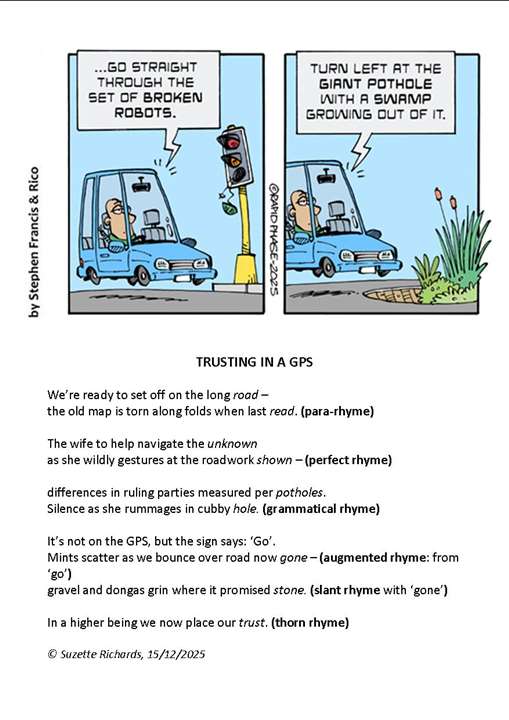
Robots in South Africa, but traffic lights elsewhere.
Conclusion
The world of rhyme is rich with possibilities, especially when paired with the many schemes available to poets—such as link rhyme, internal rhyme, or tail-rhyme. Indeed, entire poetic forms often depend on specific rhyme schemes to create their texture and resonance.
The above is by no means an exhaustive account of the many rhymes and stylistic devices poets employ to infuse their work with rhythm and resonance. While it may seem self-evident, the poet holds the advantage in shaping verse, for the subtleties of rhyme resist easy imitation. Ultimately, musicality is an innate human trait, and poetry remains one of its most enduring expressions.
I like to experiment with sound and to lead the readers along unexpected paths, encouraging them to read out loud and not to read each word with a finger underneath it.
*Link for refractory rhymes:List of English words without rhymes - Wikipedia
†The stress falls on different syllables in certain polysyllabic words depending on its application. Examples: present (noun) & present (adjective or verb); record (noun) & record (verb), insult (noun) & insult (verb), etc.
Related Articles:
Related Blog:
A Mood Palette - Suzette Richards Blog (poetrysoup.com)