Ask a room full of new writers what separates poetry from prose, and most will reach for the usual answers: rhyme, rhythm, imagery, feeling. All true, and all shared with good prose. A vivid novel has imagery. A great speech has rhythm. Song lyrics rhyme. But there is one tool that belongs to poetry almost entirely, one decision the poet makes on every single line and the prose writer never makes at all: where to end the line.
The line break is the quietest device in a poet's toolkit and, I would argue, the most powerful. It is the moment the eye stops, the breath catches, and the white space at the right-hand margin does its silent work. Learn to hear that silence, and your poems will change more than any thesaurus could change them.
What a Line Break Actually Does
A line break creates a tiny pause that punctuation cannot replicate. It is softer than a period and heavier than a comma, a hesitation with no name. Because we read a poem down as well as across, every break asks the reader to hold two things at once: the line as it stands alone, and the sentence as it continues. This double vision is where much of poetry's pleasure lives.
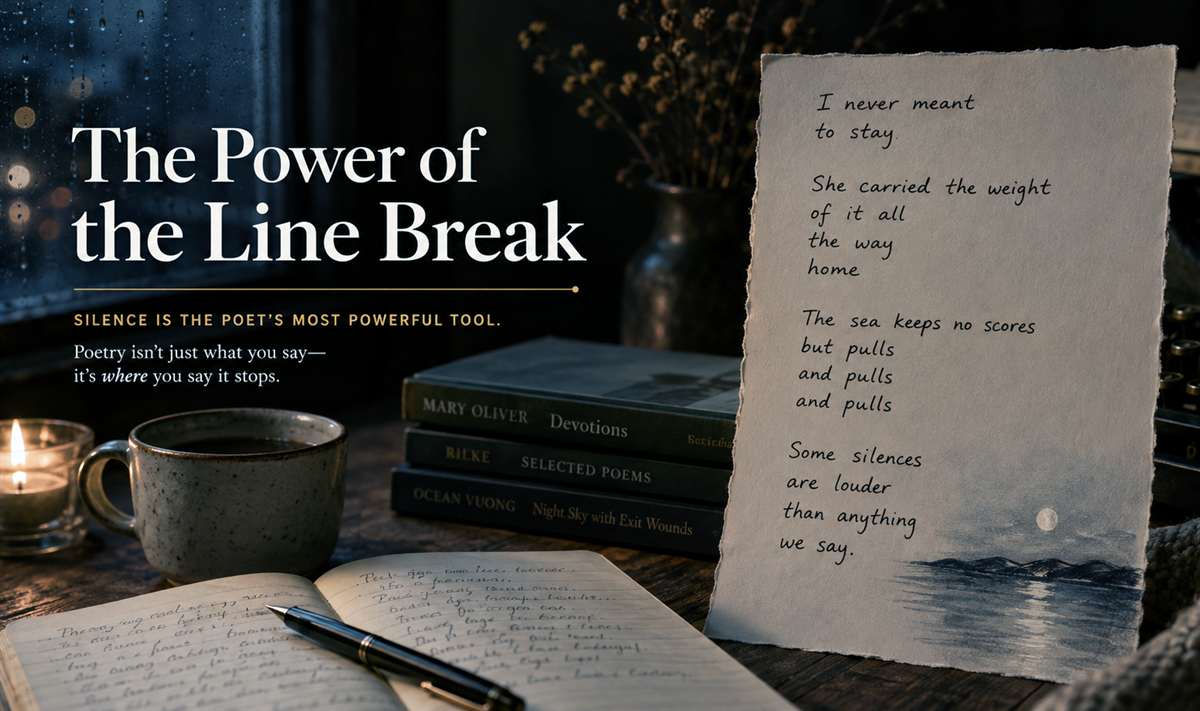
Consider a plain sentence: "I never meant to stay." Written as a single line, it simply reports a fact. But break it, and watch what happens:
I never meant to stay
Suddenly the first line carries its own small drama. "I never meant" hangs in the air, open to a hundred possibilities — meant what? — before "to stay" arrives and resolves it. For one heartbeat the reader feels the speaker's uncertainty before learning its object. That heartbeat is the poem. Nothing in the words changed; only the silence moved.
End-Stopped and Enjambed Lines
Poets have two basic options, and the art lies in knowing when to use each.
An end-stopped line concludes where a natural pause or grammatical unit concludes, usually at a mark of punctuation. It feels settled, complete, resolved. End-stopping lends a poem stateliness and calm; it lets each image land fully before the next begins. When you want the reader to rest, to absorb, to feel a thought click shut, end-stop the line.
An enjambed line does the opposite. It breaks in the middle of a phrase and spills the sense over into the next line, pulling the reader forward against the pause. Enjambment creates momentum, tension, surprise. It is the engine of urgency. When a poem needs to feel breathless, propulsive, or unresolved, enjambment carries it.
The most alive poems usually mix the two, and the contrast between them becomes a kind of music. A run of enjambed lines that finally arrives at an end-stopped one produces a feeling of relief, of landing. A series of calm end-stops broken suddenly by an enjambment produces a jolt. The poet is conducting the reader's breath.
The Rule Worth Remembering: The Last Word Wins
If you take only one practical idea from this article, take this: the word at the end of a line receives extra emphasis, whether you intend it or not. The eye lingers there. The ear leans on it. That right-hand edge is prime real estate, and beginners routinely waste it on weak words — articles, prepositions, conjunctions — while burying the strong nouns and verbs safely in the middle where no one notices them.
Watch the difference. Here the line ends limply:
She carried the weight of it all the way home
And here the same words, rebroken:
She carried the weight of it all the way home
Now "all" rings at the edge — the totality of the burden — and "home" lands as its own destination. The line breaks are doing emotional work. When you revise, run your finger down the right margin of your poem and read only those end-words in a column. If that column is a list of the, and, of, a, to, your best words are hiding. Pull them to the edge.
Breaking for Meaning, Breaking for Sound
There are two broad reasons to break a line, and skilled poets braid them together.
Breaking for meaning exploits that double vision I mentioned earlier. You break so the line reads one way alone and another way completed, letting a small ambiguity flower before it resolves. Break after a word that could open several doors, and let the next line choose one.
Breaking for sound and breath treats the line as a unit of music — roughly the amount of language a reader can hold in a single exhalation. Longer lines feel expansive, discursive, generous. Short lines feel clipped, tense, intimate. A poem about grief might use very short lines, each one a small gasp. A poem about the sea might let its lines run long as waves. Match the shape of the line to the feeling of the poem, and form and content begin to rhyme even when the words do not.
A Simple Exercise
Take any short piece of your own prose — a paragraph from a journal entry works perfectly. Do not change a single word. Only break it into lines, and break it three different ways. In the first version, end-stop everything. In the second, enjamb aggressively, breaking mid-phrase wherever you can. In the third, mix them by instinct, reading aloud as you go and breaking wherever your breath naturally wants to pause.
Read all three aloud. You will be astonished at how differently the same sentences behave. One version will feel dull, one frantic, and one, if you are lucky, alive. That third version is teaching you your own ear.
The Larger Lesson
The line break rewards a poet who slows down. In a culture that prizes speed, poetry insists on the pause — and the line break is where the poet builds those pauses by hand, one at a time. It asks you to consider not only what you are saying but the exact rhythm of its unfolding, the choreography of revelation and rest.
So the next time you draft a poem, resist the urge to break lines only where they happen to run out of room on the page. Break them where the silence should fall. Let the white space speak. Your reader may never consciously notice the work you have done there at the right-hand edge — but they will feel it, in the catch of their breath and the small, unnameable pauses your poem has taught them to take.
That feeling, invisible and precise, is the craft of poetry doing exactly what only poetry can.