What if you could reshape your thinking, reduce stress, sharpen focus, and deepen self-awareness, in just 10 minutes a day? You can. And you don’t need to be a “poet” to do it.This guide introduces a simple daily poetry habit designed for beginners and experienced writers alike. By combining expressive writing techniques, mental health benefits of poetry, and habit-building strategies, this method can help you think more clearly, process emotions, and improve your overall well-being.
Why Poetry (Not Just Journaling)?
When people search for journaling for mental health or daily writing habits, they often overlook poetry. But poetry is one of the most effective forms of expressive writing for self-improvement because it forces clarity, emotional depth, and creative thinking.
Unlike traditional journaling, poetry encourages you to:
- compress thoughts
- choose precise words
- engage emotion and imagery
- reframe experiences
This makes poetry a powerful tool for cognitive restructuring, helping you see situations from new perspectives and think more intentionally.
The 10-Minute Poetry Habit (Simple Framework)
If you’re looking for a simple daily writing routine or a 10-minute habit for mental clarity, this structured approach removes friction and makes consistency easy.
This is your repeatable system:
Minute 1–2: Pick a Prompt
Choose a single idea, emotion, or image.
Minute 3–9: Write Without Stopping
- No editing
- No grammar concerns
- No deleting
- Just flow
Minute 10: One-Line Reflection
Ask:
“What did this reveal about how I’m thinking?”
This method works because it lowers resistance and builds a consistent creative writing habit without overwhelming your schedule.
The Science Behind a 10-Minute Poetry Habit

If you’re wondering whether a daily poetry habit improves mental health, research from psychology and neuroscience strongly suggests it does. Studies on the benefits of expressive writing show measurable improvements in emotional and cognitive functioning.
1. Expressive Writing Improves Mental Health
Scientific research on expressive writing has shown improvements in both psychological and physical health. Work published by organizations like the Cambridge University Press highlights how structured writing reduces stress and improves emotional processing.
Research pioneered by psychologist James W. Pennebaker found that even short, focused writing sessions can:
- reduce stress
- improve mood
- support immune function
2. It “Offloads” Mental Noise
If you struggle with overthinking or mental clutter, writing for clarity can help free cognitive bandwidth. Research from Harvard Medical School suggests expressive writing helps offload intrusive thoughts.
This leads to:
- improved focus
- clearer thinking
- better decision-making
Your brain stops multitasking unresolved thoughts.
3. It Reduces Anxiety and Depression
Clinical findings published in journals like the Journal of Clinical Psychology show that writing for anxiety and depression can significantly reduce symptoms over time.
Benefits include:
- lower anxiety levels
- reduced rumination
- improved emotional regulation
4. It Creates Cognitive Distance
A key benefit of poetry writing for self-awareness is that it transforms emotions into language. Research from Massachusetts Institute of Technology explains how structuring thoughts creates psychological distance.
This allows you to:
- step back from emotions
- analyze instead of react
- gain perspective
5. It Builds Long-Term Resilience
Long-term studies on writing habits and mental resilience show improvements in emotional stability and memory. Insights compiled on Wikipedia summarize how journaling supports long-term well-being.
Over time, this leads to:
- stronger emotional control
- improved memory
- reduced stress-related health issues
Why 10 Minutes Works (The Psychology of Small Habits)
If you’re searching for how to build a writing habit or small daily habits that improve your life, the answer often lies in simplicity and consistency.
Short writing sessions work because they:
- reduce resistance
- fit into any schedule
- reinforce identity quickly
The concept aligns with research popularized by James Clear, which emphasizes that small, repeatable habits create lasting change.
The goal isn’t intensity, it’s consistency.
-151.jpg)
Daily 10-Minute Poetry Prompts (Use These)
If you need daily poetry prompts or creative writing ideas for beginners, these categories help you stay consistent while exploring different mental and emotional angles.
Emotional Prompts
- “Today, I felt…”
- “The thing I didn’t say was…”
- “If my stress had a voice…”
Sensory Prompts
- “The sound of today was…”
- “A color that describes my mood…”
- “The room felt like…”
Perspective Prompts
- “Write from the perspective of your fear”
- “Write as your future self”
- “Write as someone who misunderstands you”
Micro-Story Prompts
- “A moment I almost forgot…”
- “The smallest thing that mattered today…”
- “A conversation that never happened…”
What Changes After 30 Days?
If you’re curious about the benefits of daily poetry writing, consistency over 30 days can create noticeable mental and emotional shifts.
1. You Think in Patterns, Not Chaos
You begin identifying emotional triggers more easily.
2. You Respond Instead of React
Writing creates a pause between stimulus and response.
3. You Become More Observant
You notice subtle internal and external details.
4. You Gain Language for Your Emotions
And once emotions are named, they become manageable.
Best Apps to Support the Habit
If you’re looking for the best writing apps for daily journaling or apps to build a writing habit, these tools can help reinforce consistency:
- Day One – clean, distraction-free journaling
- Journey – tracks mood and writing habits
- Reflectly – guided prompts and insights
- Notion – customizable writing system
Digital tools help, but a simple notebook is often just as effective.
Common Mistakes (Avoid These)
When building a daily poetry habit, avoiding common pitfalls is key to long-term success.
- Trying to be “good” at poetry → kills authenticity
- Editing while writing → disrupts flow
- Skipping days → breaks habit formation
- Writing too long → increases resistance
The goal is consistency, not perfection.

A Sample 10-Minute Poem (Unedited Style)
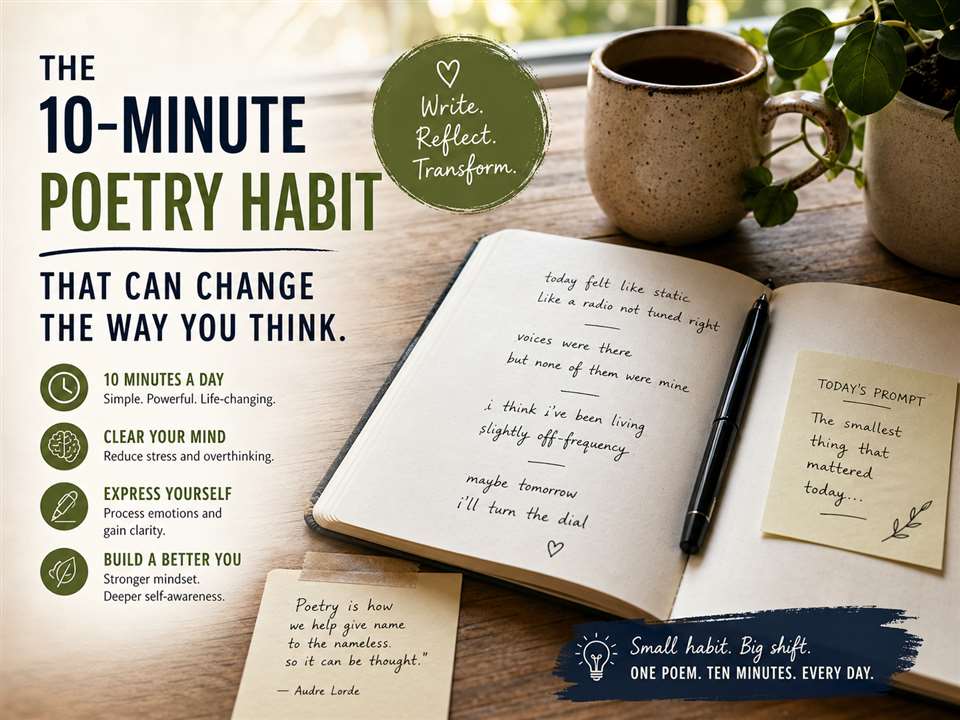
today felt like static
like a radio not tuned right
voices were there
but none of them were mine
i think i’ve been living
slightly off-frequency
maybe tomorrow
i’ll turn the dial
Final Thought: This Isn’t About Poetry
If you’re searching for simple ways to improve your thinking or daily habits for mental clarity, this approach delivers results with minimal effort.
A 10-minute poetry habit can:
- clear mental clutter
- improve emotional processing
- strengthen self-awareness
- build long-term resilience
Start today.
Set a timer for 10 minutes.
Write one honest thing.
That’s where the change begins.