Introduction: The Poetry Divide No One Wants to Admit
Poetry is having a moment again, but not in the way many expected. Instead of dusty anthologies and complex meter, today’s most viral verses live on Instagram, TikTok, and Pinterest. At the center of this movement is Rupi Kaur, whose minimalist, emotionally direct style has attracted millions, and sparked a fierce debate.

Critics ask: Is this even poetry?
Supporters counter: Why should poetry be difficult to be meaningful?
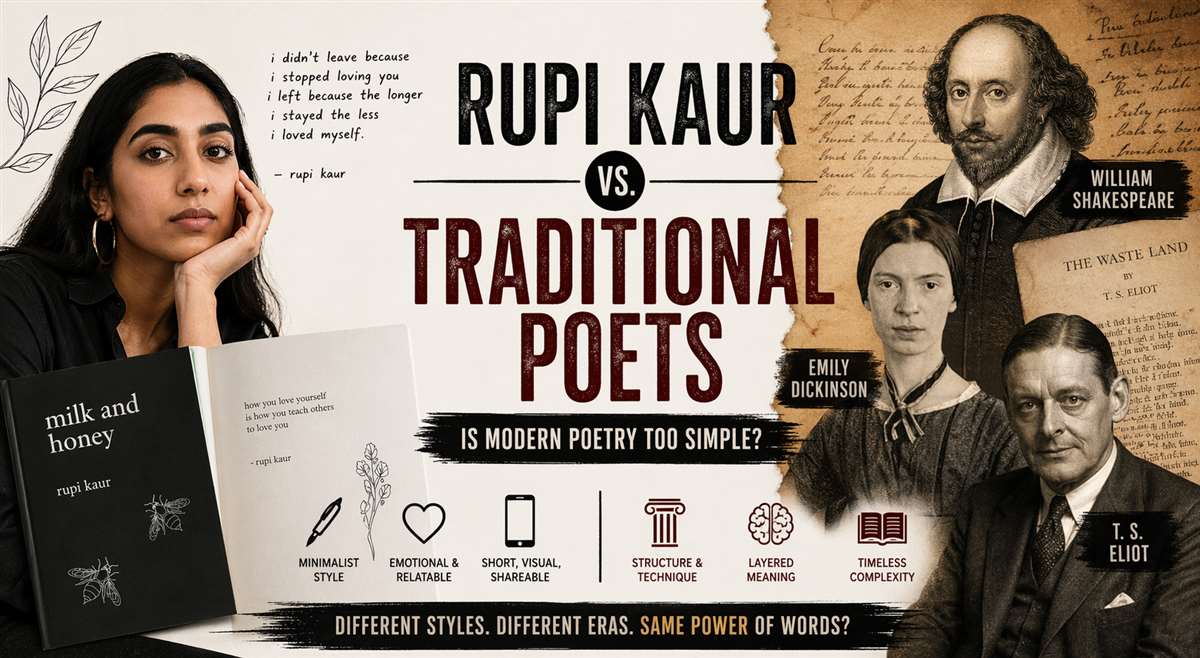
To understand this clash, we have to put Kaur side-by-side with traditional giants like William Shakespeare, Emily Dickinson, and T. S. Eliot, and confront a question that makes literary purists uncomfortable:
Has poetry evolved, or been simplified to the point of dilution?
The Rise of Rupi Kaur and Instagram Poetry
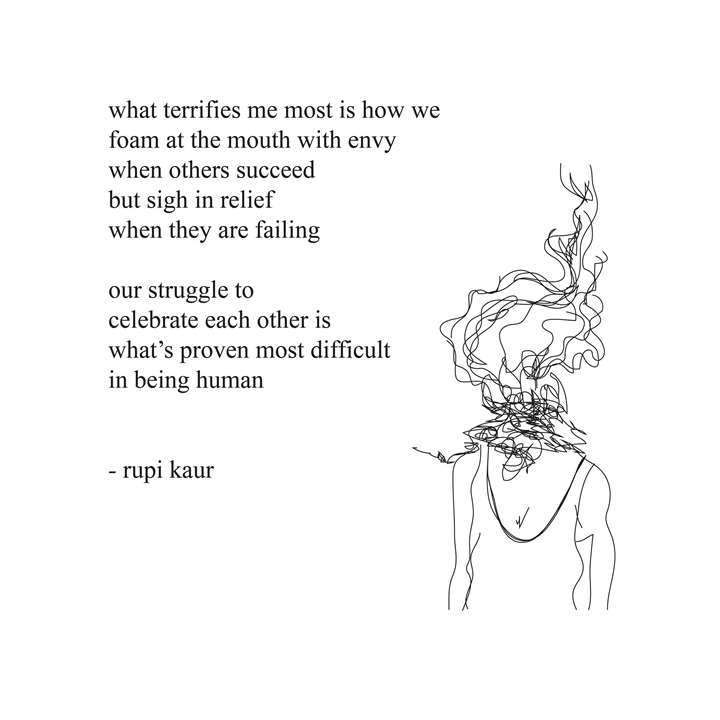
When Milk and Honey was published in 2014, it didn’t just sell, it exploded. Its success wasn’t driven by academia or literary journals, but by social media virality.
What Defines Kaur’s Style?
- Lowercase lettering
- Short, digestible lines
- Sparse punctuation
- Themes of trauma, healing, love, and identity
- Visual simplicity paired with illustration
Her poetry is designed to be consumed quickly and shared instantly, a format perfectly aligned with modern attention spans.
Why It Works
Kaur’s writing resonates because it:
- Feels accessible (no literary training required)
- Is emotionally immediate
- Functions as both poetry and self-help affirmation
For millions, this is not a downgrade, it’s liberation.
Traditional Poetry: Complexity, Craft, and Discipline

Compare that to the structured rigor of poets like William Shakespeare or T. S. Eliot, whose works demand patience and interpretation.
Hallmarks of Traditional Poetry
- Meter and rhyme (e.g., iambic pentameter)
- Dense symbolism and layered meaning
- Formal structures like sonnets and villanelles
- Cultural and historical references
Take Shakespeare’s sonnets, precise in rhythm, intricate in metaphor. Or Eliot’s The Waste Land, which is famously difficult, filled with allusions that require deep literary knowledge.
The Trade-Off
Traditional poetry offers:
- Depth and longevity
- Intellectual challenge
- Technical mastery
But it also risks alienating casual readers.
The Core Debate: Simplicity vs. Substance
This is where the controversy intensifies.
Critics Say: Modern Poetry Is Too Simple
Detractors argue that Kaur’s work:
- Lacks technical skill
- Relies on clichés
- Confuses relatability with profundity
Some even claim it’s closer to motivational quotes than poetry.
Supporters Say: That’s the Point
Fans argue:
- Poetry doesn’t need strict rules to be valid
- Emotional clarity is more important than complexity
- Accessibility expands poetry’s audience
In this view, Kaur is doing what poets like Walt Whitman once did, breaking rules to redefine the form.
A Side-by-Side Comparison
|
Element
|
Rupi Kaur
|
Traditional Poets
|
|
Structure
|
Free-form, minimalist
|
Strict forms, meter
|
|
Accessibility
|
Immediate
|
Often challenging
|
|
Length
|
Very short
|
Varies, often longer
|
|
Themes
|
Personal, emotional
|
Universal, philosophical
|
|
Interpretation
|
Direct
|
Layered, symbolic
|
What This Really Reveals
This isn’t just a stylistic difference; it’s a philosophical divide:
- Is poetry meant to be felt instantly?
- Or slowly unpacked over time?
Is Simplicity Actually a Skill?
Here’s where critics may be underestimating the craft.
Simplicity is not inherently easy. Consider the precision required in a haiku or the distilled clarity of poets like Matsuo Basho. Writing something short that resonates deeply can be just as difficult as composing a complex sonnet.
The real question isn’t whether Kaur’s poetry is simple, it’s whether it’s effective.
The Algorithm Effect: Poetry in the Age of Scroll
Modern poetry isn’t just shaped by artistic choice; it’s shaped by platform design.
- Short content performs better
- Visual formatting matters
- Shareability drives success
In other words, today’s poetry is partially written for algorithms, not just audiences.
Would Emily Dickinson have written differently if she had Instagram? It’s not as absurd a question as it sounds.
So… Is Modern Poetry “Too Simple”?
The answer depends on what you believe poetry should do.
- If poetry is about technical excellence and layered meaning, then yes, modern minimalist poetry may feel lacking.
- If poetry is about connection and emotional impact, then simplicity might be its greatest strength.
A More Honest Conclusion
Rather than replacing traditional poetry, writers like Rupi Kaur have created a parallel lane, one that prioritizes reach over rigor.
And that may be exactly why it’s thriving.
Final Thought: Evolution or Erosion?

Every generation redefines art, and every generation faces backlash for it.
What William Shakespeare was to Elizabethan audiences might not look so different from what Kaur is to ours: a writer meeting people where they are.
The real controversy isn’t whether modern poetry is too simple.
It’s whether simplicity is something we’re willing to respect.