
Poetry essays are strange territory. Half analysis, half confession. You’re supposed to talk about structure, tone, metaphor, historical context… but also somehow keep the pulse of the poem alive while you do it. Most writing tools were not built for that tension. They either flatten the poem into academic bullet points or drift into decorative nonsense.
AI entered that space like a loud instrument in a quiet room. Mostly useful, even brilliant at times, but mostly just a little off-track in a way that makes you stop and read what you generated again.
This is the actual conversation started: not if AI can write or not, but whether it can process poetry long enough and still talk about it instead of killing it.
When AI meets poetry essays, something subtle breaks first
Poetry essays are not summaries. They are interpretations with pressure behind them. You’re dealing with compressed language, where every word is doing too much work already.
AI tools, especially general essay generators, tend to do one thing early on: they smooth everything out.
A metaphor becomes “symbolic language.”
A rupture in tone becomes “a shift in mood.”
A deliberate ambiguity becomes “unclear meaning.”
It’s not wrong. It’s just sterile in a way that poetry refuses to tolerate.
If you’ve ever written or read enough poetry analysis, you start noticing a pattern. The weakest essays don’t misunderstand the poem. They over-explain it until it stops breathing.
That’s the real risk with automation in this space.
Poetry doesn’t need explanation first. It needs attention.
What AI essay writer tools actually do well (and where they quietly fail)
Modern AI writing tools are built on prediction. They’re good at completing patterns, not sitting inside contradictions. That matters more than it sounds.
For poetry essays, AI tends to be strong at:
- Structuring arguments quickly
- Generating background context on poets or movements
- Offering multiple interpretations of a line
- Helping non-native writers organize thoughts into academic English
But there’s a recurring failure point that shows up if you use them enough.
They treat interpretation like certainty.
Poetry rarely works that way. A line by Sylvia Plath or T.S. Eliot doesn’t “mean” one thing. It bends depending on where you stand when you read it. AI, unless guided carefully, often locks onto the first stable interpretation it finds and builds an entire essay on that foundation.
That’s where the writing starts to feel like it was assembled, not experienced.
And readers can feel that even if they can’t explain why.
The middle ground: where tools actually become useful
There’s a practical way writers are using AI now, especially in academic-style poetry essays. Not as replacement, but as scaffolding.
This is where tools like structured generators and rewriting systems come in. One example is the AI essay writer tool, which is designed more for shaping and refining drafts than replacing thought.
Used carefully, tools like this help with:
- Turning rough notes into readable paragraphs
- Cleaning up grammar without flattening voice
- Expanding short analysis into structured argument flow
- Rewriting repetitive sections without losing meaning
The key difference is intent. If you go in asking it to “write a poetry essay,” you’ll get something that feels like it passed through a machine. If you go in with fragments—observations, interpretations, contradictions—you get something closer to usable raw material.
Still not finished writing. Just less messy clay.
And poetry essays, more than most writing forms, need that kind of clay before shaping begins.
Where things usually go wrong (and it’s not just the tool)
There’s a pattern that shows up again and again.
People trust the tool too early.
They drop in the poem, press generate, and expect insight. But poetry doesn’t work on extraction. It works on friction. You have to wrestle with it a little.
AI removes that friction unless you deliberately put it back in.
That’s why so many AI-assisted essays feel oddly flat even when they’re “correct.” They never hit resistance. No moment where the writer struggles with meaning and has to choose between interpretations.
That struggle is the essay.
Without it, you just get polished commentary floating above the poem, never inside it.
A quick shift in perspective most writers miss
If you spend time on communities like Poems by Form, Theme & Occasion, you start noticing something interesting. The strongest analyses don’t always come from the most technical writers.
They come from people who stayed close to the emotional texture of the poem before they tried to explain it.
That’s also where AI assistance becomes tricky.
It pushes you toward explanation too quickly. It rewards completion. Poetry rewards hesitation.
So the real skill is learning when not to accept the first answer the tool gives you.
Using AI without letting it flatten the poem
There’s a working approach that many writers quietly use, even if they don’t label it this way:
Start human. Switch to machine. Then switch back.
- Read the poem without tools. No notes. Just reaction.
- Note down what’s not stable and what’s confusing or emotionally charged.
- Expand the raw fragments or clusters into structured paragraphs using AI
- Go back and cut anything that feels too clean or too certain.
That last step matters more than people think. AI has a tendency to remove edge. But poetry lives in edge.
Another overlooked point: tone control. If you don’t actively steer it, AI defaults to academic neutrality. That works for some subjects. Poetry essays aren’t one of them.
A good essay on poetry should still feel like someone is thinking while writing it. Not reporting after the thinking is done.
What AI cannot yet replace in poetry analysis
There’s a gap that no tool has really crossed.
AI can describe metaphor. It can even identify themes. But it struggles with personal collision—that moment where a poem doesn’t just mean something, it hits against your own memory or perception and changes how you read it.
That part is not structural. It’s not language-based in a clean sense.
It’s interpretive friction between reader and text.
And without that, poetry essays become accurate but hollow.
Where PoetrySoup fits into this evolving workflow
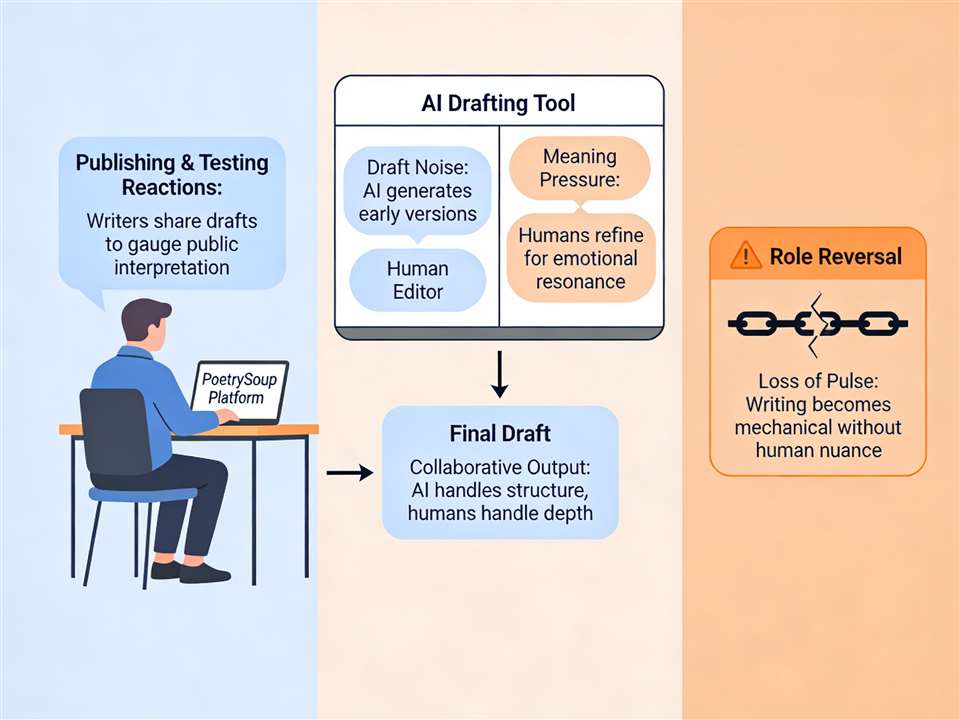
Platforms like PoetrySoup exist in a strange intersection now. Writers use them not just to publish, but to test reactions. To see how interpretation lands in public space.
AI tools enter that ecosystem quietly. They don’t replace posting or reading. They sit behind the drafting process, shaping early versions before human feedback takes over again.
That separation is important. AI handles the draft noise. Humans handle meaning pressure.
If those roles get reversed, the writing starts to lose its pulse.
Final thought: poetry essays are not a formatting problem
There’s a temptation to treat poetry essays as something that can be optimized. Better structure, cleaner grammar, faster generation.
But poetry itself resists that kind of efficiency.
AI essay tools can absolutely help with clarity, pacing, and structure. They can reduce friction in the writing process. But they cannot decide what the poem does to you.
That part still belongs to the writer.
And if that part is missing, the essay might still look correct on the surface, but it will feel like it’s describing a song it never actually heard.
Not wrong. Just distant.